
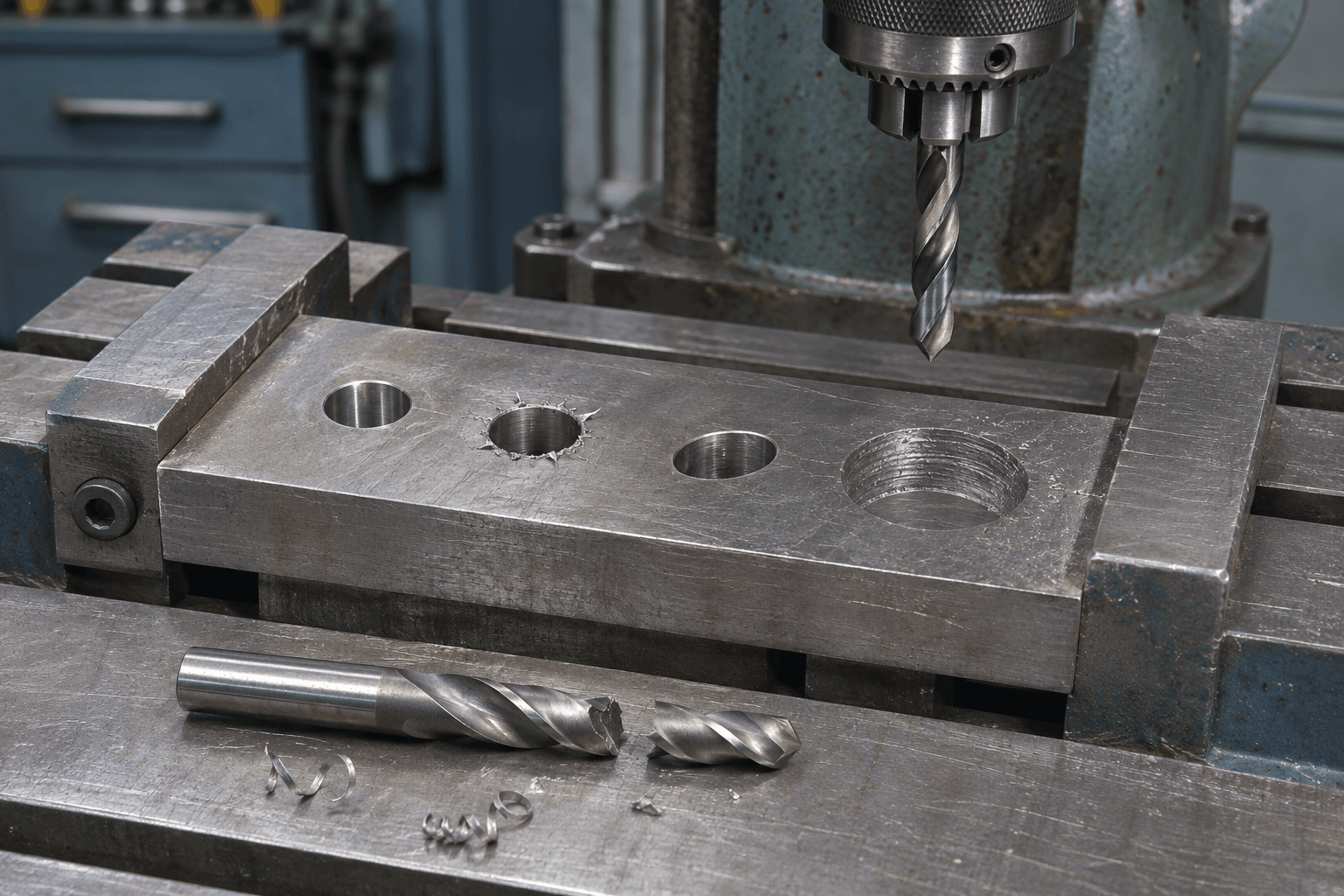
Drilling is one of the most common machining operations in metalworking and industrial manufacturing. From producing holes in steel plates to machining precision mechanical components, drill bits play an essential role in achieving accurate and reliable results.
However, drilling operations can encounter various problems that affect hole quality, machining efficiency, and tool life. Issues such as oversized holes, burr formation, drill breakage, and poor surface finishes can increase production costs and cause unnecessary downtime.
Understanding the causes of these problems is essential for improving drilling performance. In this guide, we will discuss six common drilling problems and practical solutions for achieving better machining results.
1. Oversized or Inaccurate Holes
One common drilling problem is producing holes that are larger than the required diameter or have poor dimensional accuracy.
Several factors can contribute to this issue:
- Uneven cutting lips or incorrect drill point geometry
- Excessive spindle runout
- Poor workpiece clamping
- Drill bit deflection during machining
Solutions:
Check the drill bit condition and ensure that both cutting lips are symmetrical. Inspect the machine chuck and spindle for excessive runout. Secure the workpiece firmly and use suitable drilling parameters.
For applications requiring high dimensional accuracy, consider using a drilling operation followed by reaming to achieve the final hole size and surface quality.
2. Burr Formation Around the Hole
Burrs are unwanted raised edges or small pieces of material that remain around a drilled hole. They commonly appear at the entrance or exit of the workpiece.
Burr formation is influenced by workpiece material, cutting conditions, drill geometry, and tool sharpness.
Solutions:
Use a sharp drill bit with suitable cutting geometry. Select appropriate feed rates and cutting speeds according to the workpiece material.
When drilling thin metal sheets, proper workpiece support can help reduce deformation and exit burrs. Additional deburring or chamfering operations may be required when a smooth edge is essential.
3. Drill Bit Breakage
Drill bit breakage can interrupt production and potentially damage the workpiece or machine.
Common causes include:
- Excessive feed pressure
- Incorrect cutting speed
- Poor chip evacuation
- Insufficient lubrication
- Misalignment between the drill bit and workpiece
- Excessive vibration
Solutions:
Choose a drill bit suitable for the workpiece material and hole dimensions. Adjust the cutting speed and feed rate according to the manufacturer's recommendations.
Ensure effective chip removal, especially when drilling deep holes. Use suitable cutting fluid when required and check machine rigidity before starting the operation.
Avoid forcing a drill bit through the material when cutting resistance becomes unusually high.
4. Poor Hole Surface Finish
A rough or uneven hole surface can affect the accuracy and performance of assembled components.
This problem may result from worn cutting edges, excessive vibration, unsuitable cutting parameters, or poor chip evacuation.
Solutions:
Inspect the cutting edges regularly and replace severely worn drill bits. Maintain stable machining conditions and use suitable lubrication.
For demanding applications, selecting a drill bit with appropriate geometry and manufacturing precision can help improve hole surface quality.
If the required surface finish cannot be achieved through drilling alone, a secondary finishing process may be necessary.
5. Drill Bit Wandering During Initial Cutting
Drill wandering occurs when the drill bit moves away from the intended drilling position during initial engagement.
This can result in misplaced holes, inaccurate dimensions, and damage to the workpiece.
Common causes include an uneven workpiece surface, incorrect drill alignment, excessive initial feed pressure, and unsuitable drill point geometry.
Solutions:
Mark the drilling position accurately before machining. Use a center punch or suitable spotting drill when necessary.
A split-point drill bit can also help improve initial positioning by reducing the tendency to walk across the workpiece surface.
Ensure that the drill is properly aligned and that the workpiece is securely clamped.
6. Chip Accumulation and Poor Chip Evacuation
During drilling, chips must move out of the hole through the drill bit flutes. When chips accumulate, cutting resistance and heat generation may increase.
This is particularly important in deep-hole drilling and when machining ductile materials that produce long, continuous chips.
Solutions:
Choose a drill bit with suitable flute geometry for the workpiece material. Use appropriate cutting fluid and ensure effective chip evacuation.
For deeper holes, periodic peck drilling may help remove accumulated chips, depending on the application and tool manufacturer's recommendations.
Avoid allowing chips to remain trapped inside the hole, as this can accelerate tool wear and increase the risk of breakage.
7. How to Prevent Drilling Problems Before They Occur
Preventive measures are often more effective than correcting machining defects after they appear.
Industrial users should establish consistent drilling procedures and pay attention to the following factors:
- Select drill bits according to the workpiece material and required hole dimensions.
- Check drill bit sharpness and geometry before operation.
- Verify machine alignment and spindle condition.
- Secure the workpiece properly.
- Use suitable cutting speeds, feed rates, and lubrication.
- Monitor chip formation and evacuation.
- Inspect finished holes regularly to identify quality issues early.
Consistent inspection and process control help reduce production interruptions and improve overall machining efficiency.
Conclusion
Drilling problems can affect product quality, tool life, and manufacturing productivity. Oversized holes, burr formation, drill breakage, poor surface finishes, and chip accumulation are common challenges in industrial drilling operations.
By understanding their causes and applying appropriate solutions, manufacturers can improve hole accuracy, reduce tool damage, and maintain more stable production processes.
TAPMEC supplies HSS, HSS-Co, and carbide drill bits for international distributors, wholesalers, and industrial customers. We offer various specifications to support different metalworking and drilling applications.
Contact TAPMEC to discuss your drilling tool requirements and explore suitable product solutions.


