
In high-volume manufacturing, the price of a tap is only one part of the real threading cost. A cheaper tool may seem attractive, but if it wears quickly, breaks unexpectedly, increases machine downtime, or produces rejected threads, the total cost per hole can be much higher.
For automotive, machinery, electronics, appliance, and general industrial production, the more useful metric is cost per acceptable threaded hole. Reducing this cost requires a complete process approach that considers tool life, cycle time, machine utilization, scrap, coolant, inspection, and tool-change frequency.
1. Calculate the Real Cost per Hole
A simple starting formula is:
Cost per hole = Total tapping cost ÷ Number of acceptable threaded holes
Total cost should include more than tap purchase price. It may also include machine time, labor, tool changes, coolant, scrap, inspection, broken-tap removal, and downtime.
This gives purchasing and manufacturing teams a more realistic basis for comparing tools.
2. Select the Right Tap for the Material
Using the wrong tap geometry or substrate quickly increases cost.
HSS or HSS-Co taps may be economical for general steels. PM-HSS can provide better wear resistance in demanding materials. Carbide may offer longer life and higher cutting speeds in abrasive materials when machine rigidity is excellent.
The tap should also match the workpiece. Stainless steel, cast iron, aluminum, high-silicon aluminum, and alloy steel need different combinations of geometry, coating, and cutting conditions.
A more expensive application-specific tap can still be cheaper per hole if it lasts significantly longer.
3. Match Flute Geometry to the Hole
Chip evacuation strongly affects tap life.
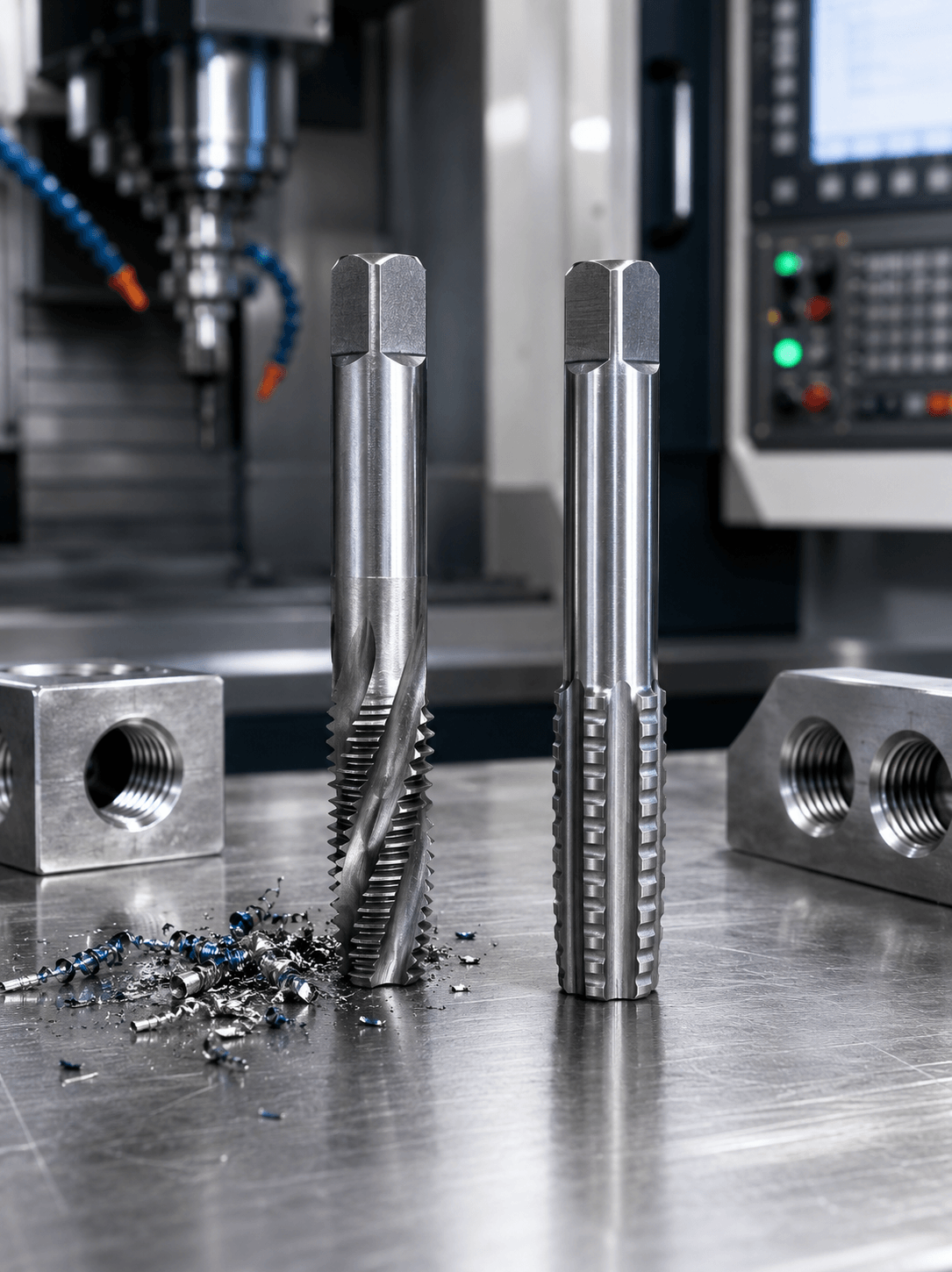
For through holes, spiral point taps are often efficient because they push chips forward. For blind holes, spiral flute taps are usually preferred because they pull chips back toward the entrance.
Straight flute taps can work well in short-chipping materials such as cast iron.
The wrong flute style can cause chip packing, higher torque, thread damage, and breakage.
4. Optimize the Pre-Drilled Hole Size
An undersized hole increases the amount of material the tap must remove, raising torque, heat, and wear.
A hole that is too large can reduce thread engagement and lead to rejected parts.
In mass production, the objective is not simply to maximize thread percentage. The hole should reduce unnecessary tapping load while still meeting the required thread specification.
Measure actual hole diameter regularly because drill wear and runout can change it during production.
5. Use the Right Coating
Coatings can improve wear resistance and reduce friction when matched correctly to the application.
TiN is common for general-purpose tapping. TiCN offers higher wear resistance in many steel applications. TiAlN is useful where higher cutting temperatures are expected. DLC can help reduce aluminum adhesion in suitable non-ferrous applications.
The best coating is not necessarily the most expensive. Compare actual tool life and cost per hole under controlled conditions.
6. Improve Lubrication and Coolant Delivery
Poor lubrication increases friction, heat, and tapping torque.
A suitable coolant or tapping fluid helps protect the cutting edge and improve thread finish. In deep blind holes, coolant-thru taps can provide more reliable lubrication and chip evacuation.
Coolant concentration, pressure, cleanliness, and delivery direction should be monitored. Small improvements can produce meaningful tool-life gains across thousands of holes.
7. Control Runout and Toolholding
Excessive runout creates uneven loading on the tap teeth and can cause premature wear or chipping.
Use clean collets, accurate tapping holders, rigid fixtures, and properly maintained spindles. Check runout regularly, especially for small or carbide taps.
A better holder may cost more initially but can reduce tool consumption and unexpected failures.
8. Optimize Cutting Speed
Higher spindle speed can reduce cycle time, but excessive speed may shorten tap life.
The lowest cost per hole is usually achieved by balancing cycle time and tool life, not by using the highest possible RPM.
Start with the tap manufacturer's recommended cutting data, then adjust while monitoring torque, thread quality, and tool wear.
If a speed increase saves seconds but cuts tool life dramatically, the faster process may cost more overall.
9. Replace Taps Before Catastrophic Failure
Running a tap until it breaks is rarely economical.
A broken tap can stop the machine, damage the workpiece, require EDM removal, or turn an expensive component into scrap.
Monitor tool life using thread count, spindle load, torque, gauge results, and cutting-edge condition.
In stable production, planned replacement after a proven number of holes reduces unexpected downtime.
10. Reduce Tool-Change and Setup Time
Tool changes create non-cutting time.
Use standardized holders, preset tools, consistent offsets, and documented replacement procedures. Prepare replacement tools before the current tap reaches its planned life limit.
Longer-life taps can also reduce the number of tool changes required per shift.
11. Compare Suppliers by Batch Consistency
A tap that performs well once is less valuable than one that performs predictably across every batch.
Evaluate tools from multiple production lots. Compare dimensions, hardness, coating condition, tool life, and failure patterns.
Consistent tools make it easier to establish planned replacement intervals and stable machining parameters.
12. Track the Right Production Data
Useful data includes holes per tap, cycle time, tool-change frequency, scrap rate, tap breakage, spindle load, thread gauge failures, and machine downtime.
Compare these metrics before and after changes to tap type, coating, coolant, speed, or hole size.
Data-driven improvements are more reliable than changing several variables based on guesswork.
Conclusion
Reducing cost per hole in mass production tapping requires more than buying cheaper taps.
The best results come from matching the tap to the material and hole type, controlling pre-drilled hole size, using suitable coatings and coolant, minimizing runout, optimizing cutting speed, and replacing tools before failure.
Manufacturers should evaluate total production cost, including cycle time, tool life, scrap, downtime, and tool-change labor.
When these factors are improved together, even small gains in tool life or process stability can generate significant savings across large production volumes.
The goal is not the lowest tap price or the longest possible tool life. It is the lowest reliable cost for every acceptable threaded hole produced.


