
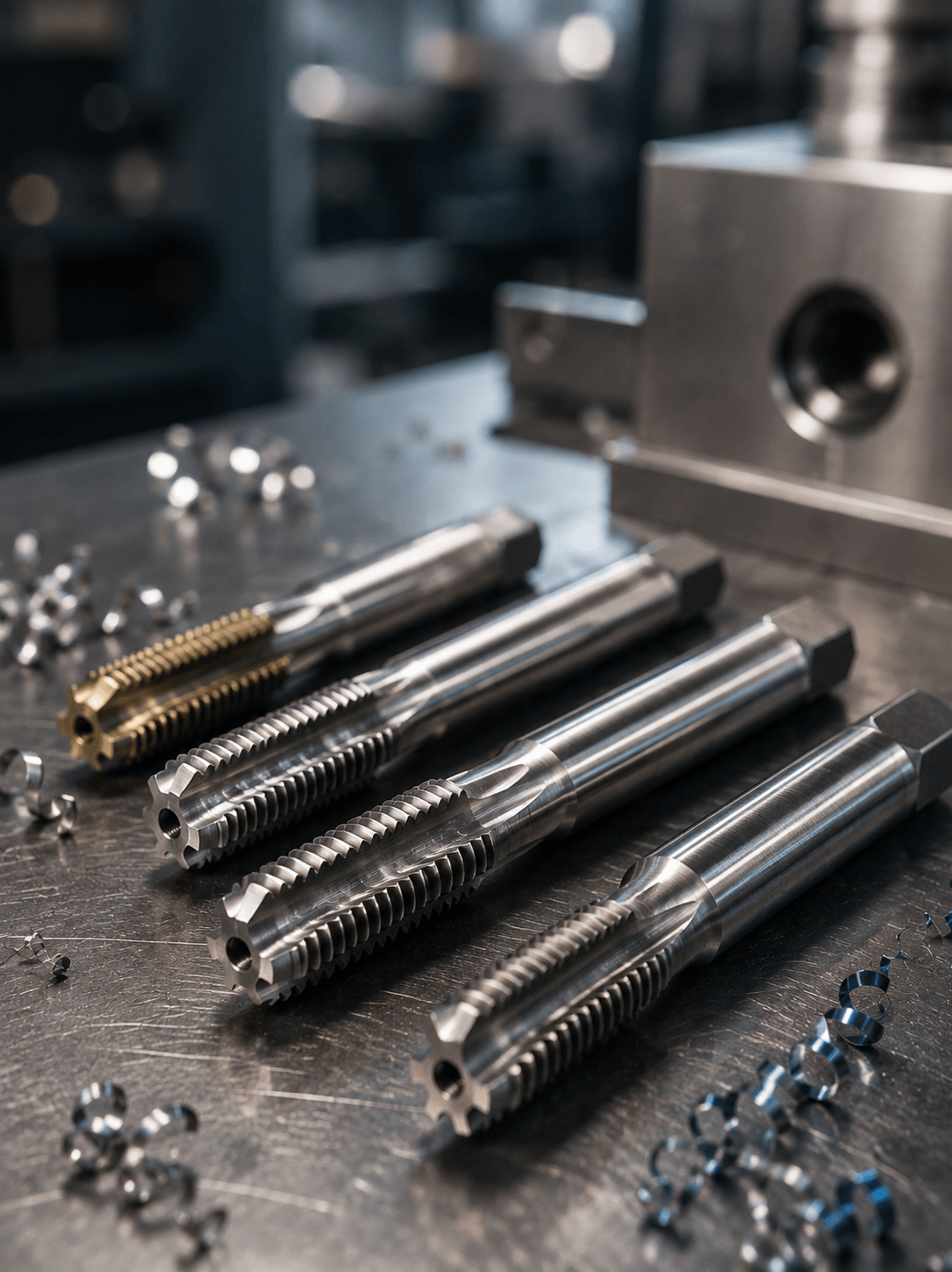
Aluminum is widely used in automotive manufacturing because it combines low weight, corrosion resistance, and good machinability. Engine housings, transmission cases, battery trays, suspension parts, pump bodies, and structural components may all require large numbers of threaded holes.
For high-volume production, tapping speed and tool life are critical. Two common options are cut taps and form taps. Both can produce accurate internal threads, but they work differently and suit different aluminum alloys, hole conditions, and production goals.
This article compares form taps and cut taps for high-speed tapping in automotive aluminum components.
1. How Cut Taps Work
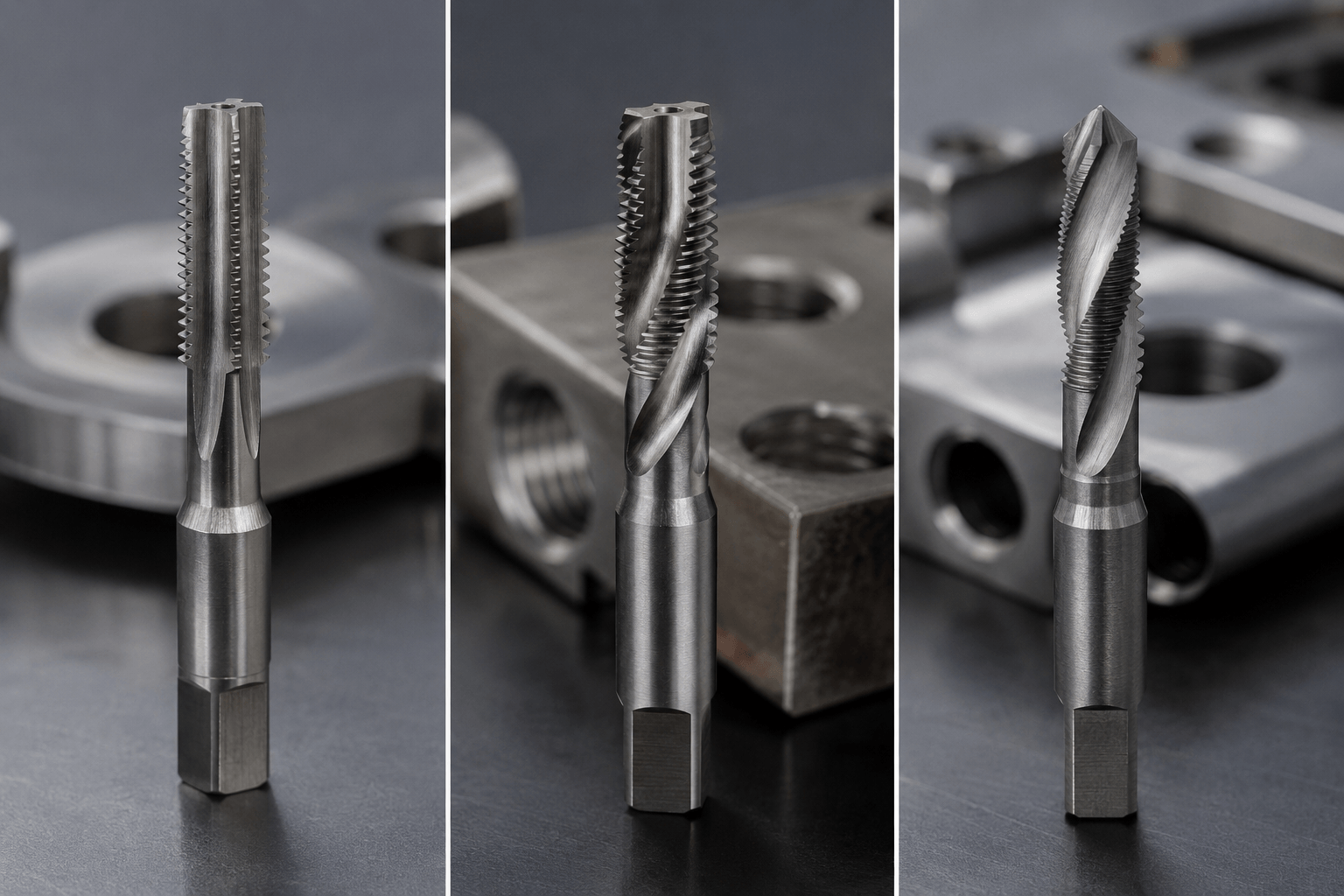
A cut tap creates the internal thread by removing material. Its cutting teeth shear metal from the wall of a pre-drilled hole, producing chips that must be evacuated through the flutes.
Common designs include straight flute, spiral point, and spiral flute taps. Spiral point taps are often used for through holes because they push chips forward, while spiral flute taps pull chips back from blind holes.
Cut taps are versatile and can be used in a wide range of aluminum alloys.
2. How Form Taps Work
A form tap, also called a roll tap or fluteless tap, does not cut the workpiece. Instead, it plastically displaces aluminum around the tap lobes to create the thread profile.
Because no material is removed, no chips are produced. This is a major advantage in automated automotive production, where chip control can limit reliability.
Form taps are especially suitable for ductile aluminum alloys, but the pre-drilled hole diameter must be controlled carefully.
3. Why Aluminum Is Well Suited to Form Tapping
Many aluminum alloys have enough ductility to flow plastically under pressure. This allows the material to move into the thread shape rather than being cut away.
Form tapping can provide several benefits:
- No chips
- Smooth thread surfaces
- Strong thread flanks
- Good tool life
- High process repeatability
However, not every aluminum alloy is equally suitable. High-silicon or relatively brittle aluminum alloys may be less favorable for forming.
4. High-Speed Productivity
Automotive manufacturers often need to produce thousands of identical threaded holes, so cycle time matters.
Form taps can perform well at high speeds because there are no chips to evacuate. This reduces interruptions caused by chip packing.
Cut taps can also operate efficiently when the flute geometry, coolant, and hole type are properly matched. For through holes, spiral point taps provide effective chip removal, while blind holes generally require more careful chip control.
5. Hole Size Requirements
Pre-drilled hole diameter is important for both tap types, but it is especially critical for form taps.
With a cut tap, a smaller hole increases the amount of material removed and raises torque.
With a form tap, hole diameter directly controls how much material is displaced. If the hole is too small, forming pressure can rise sharply. If it is too large, the thread may not form completely.
Automotive production therefore requires close drilling control when form tapping is used.
6. Lubrication and Friction
Form tapping generates high contact pressure between the tool and aluminum, so effective lubrication is essential. Poor lubrication can increase friction, torque, heat, and material adhesion.
Cut taps also need good lubrication because aluminum can stick to the cutting edges.
Polished tool surfaces and suitable low-friction coatings can help reduce adhesion and stabilize tapping performance.
7. Chip Control
Chip management is one of the biggest differences between the two processes.
Cut taps generate chips that must leave the hole reliably. If chips become trapped, tapping torque increases and the tool may break or damage the thread.
Form taps eliminate this problem because they produce no chips. For deep blind holes or complex automotive parts, this can be a significant advantage.
8. Tool Life and Aluminum Alloy
Tool life depends on alloy composition, tapping speed, lubrication, hole preparation, coating, and machine alignment.
Form taps can provide long life in suitable ductile aluminum because they do not rely on sharp cutting edges in the same way as cut taps.
In high-silicon aluminum, however, hard silicon particles can cause severe abrasive wear. Specialized cut taps, carbide tools, or wear-resistant coatings may be more appropriate depending on the application.
9. Blind and Through Holes
Cut taps offer specialized geometries for different hole types. Spiral point taps are commonly selected for through holes, while spiral flute taps are widely used for blind holes.
Form taps can be used in both through and blind holes because they do not generate chips. This makes them attractive for blind holes where chip packing is difficult to control.
Hole depth, coolant access, and required full-thread depth must still be considered.
10. Machine Requirements
High-speed tapping requires accurate CNC synchronization and rigid machine conditions.
The spindle feed must match the thread pitch, and the tool should be held with minimal runout.
Form taps often generate higher torque than comparable cut taps because they deform rather than remove material. The machine and toolholder must therefore handle the required load.
Torque monitoring can help identify changes in hole size, lubrication, or tool condition.
11. Which Tap Is Better for Automotive Aluminum?
Neither tap type is universally better.
A form tap is often a strong choice when the aluminum alloy is ductile, chip-free production is valuable, hole size can be controlled precisely, and high-volume repeatability is required.
A cut tap may be better when the alloy has limited ductility, contains higher silicon levels, or when chip-producing tapping is easier to control than forming torque.
The final decision should consider cost per threaded hole, not just tool price. Cycle time, tool life, scrap risk, coolant, and machine downtime all matter.
Conclusion
Both form taps and cut taps can deliver reliable internal threads in automotive aluminum components.
Cut taps offer flexibility across a wide range of alloys and provide specialized chip-control geometries for through and blind holes.
Form taps eliminate chips and can offer smooth threads, long tool life, and excellent repeatability in ductile aluminum.
For high-speed automotive production, the best choice depends on alloy composition, hole type, pre-drilled diameter control, lubrication, machine torque, and required cycle time.
By evaluating the complete process, manufacturers can select the tapping method that provides the best balance of thread quality, productivity, and cost efficiency.


