
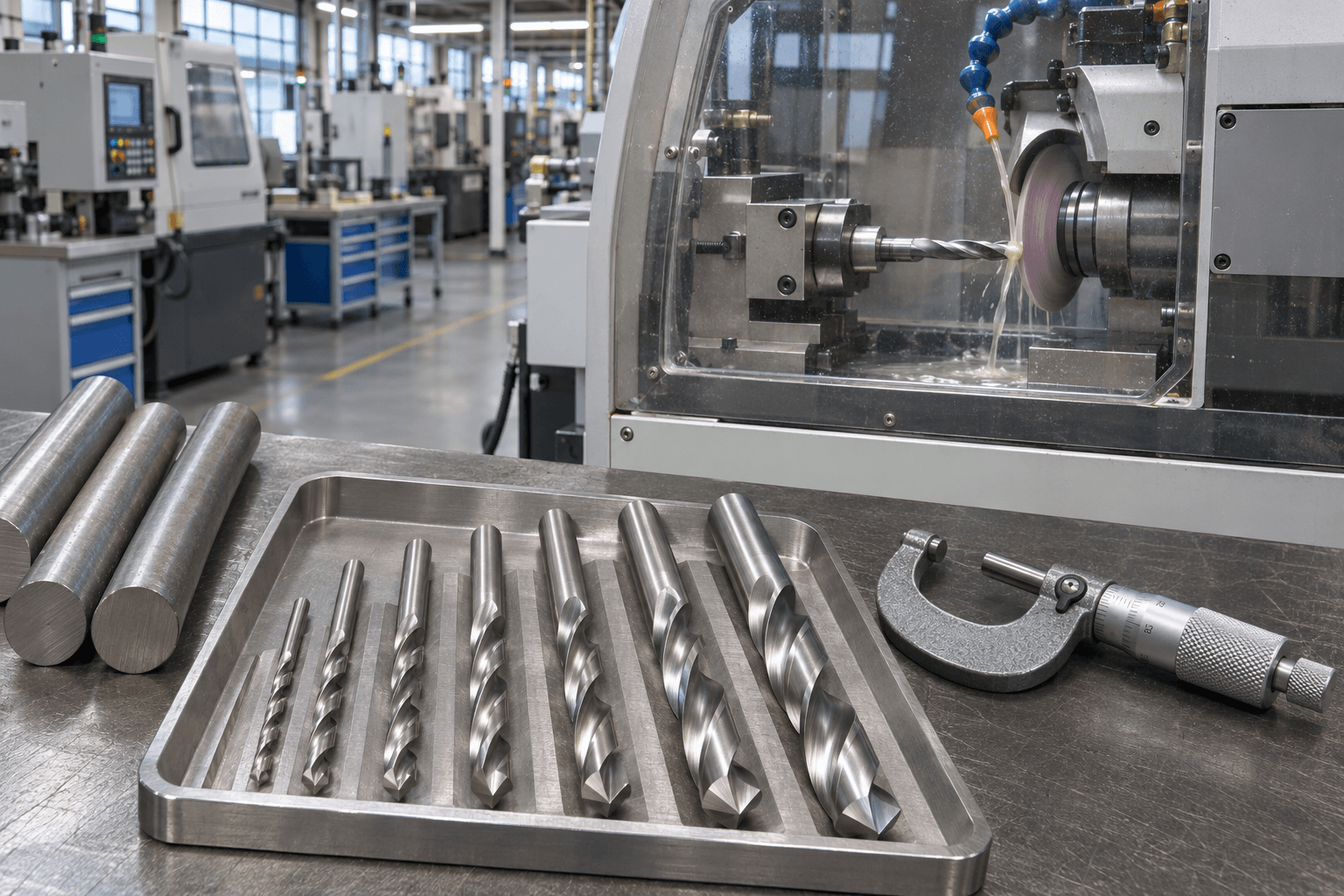
HSS drill bits are widely used in metalworking, machinery manufacturing, automotive production, and general industrial applications. Their cutting performance depends not only on the raw material but also on manufacturing processes, heat treatment, grinding accuracy, and quality inspection.
For industrial buyers and tool distributors, understanding how HSS drill bits are manufactured helps evaluate product quality and select reliable suppliers.
In this article, we will explore the main manufacturing stages of HSS drill bits, from raw material preparation to final quality inspection.
1. Raw Material Selection
The manufacturing process begins with selecting suitable high-speed steel (HSS) materials.
HSS is widely used for drill bit production because it offers a combination of hardness, toughness, and wear resistance. Common grades include M2 and M35.
- HSS M2: A versatile high-speed steel grade suitable for general-purpose drilling applications.
- HSS M35: A cobalt-containing high-speed steel that provides improved hot hardness and wear resistance.
The choice of material depends on the intended application, workpiece materials, and required cutting performance.
Consistent raw material quality is essential for producing reliable drill bits.
2. Cutting and Blank Preparation
After material selection, steel bars or rods are cut into blanks according to the required drill bit dimensions.
The blank length and diameter are determined by the finished product specifications.
During this stage, manufacturers must control dimensional consistency and ensure that the material is free from visible defects.
Proper blank preparation provides a stable foundation for subsequent machining operations.
3. Flute Grinding and Geometry Formation
Flute grinding is one of the most important manufacturing stages for twist drill bits.
The flutes are the spiral grooves along the drill body. They provide space for chip evacuation and help guide chips away from the cutting area.
Specialized grinding machines are used to create the required flute geometry.
Several factors must be controlled:
- Flute depth and width
- Helix angle
- Cutting edge symmetry
- Web thickness
- Overall dimensional accuracy
Accurate flute grinding helps ensure balanced cutting performance and effective chip removal.
4. Heat Treatment
Heat treatment plays an important role in developing the mechanical properties of HSS drill bits.
The process generally involves controlled heating, quenching, and tempering.
Hardening: The drill bit is heated to a specified temperature and then rapidly cooled to increase hardness.
Tempering: The hardened tool is reheated under controlled conditions to reduce brittleness and improve toughness.
The temperature, holding time, and cooling conditions must be carefully controlled.
Improper heat treatment may result in insufficient hardness, excessive brittleness, or inconsistent tool performance.
5. Point Grinding and Cutting Edge Formation
After heat treatment, the drill point is ground to achieve the required cutting geometry.
This stage determines important features such as point angle, cutting lip length, and chisel edge configuration.
Common drill point angles include 118° and 135°, depending on the intended application.
Some drill bits also receive split-point grinding to improve initial positioning and reduce walking during drilling.
Consistent point grinding is essential for balanced cutting forces and accurate hole production.
6. Surface Treatment and Coating
Depending on product requirements, HSS drill bits may receive additional surface treatments or coatings.
Common options include:
- Bright Finish: A polished surface without an additional coating, commonly used for general-purpose drilling.
- Black Oxide: A surface treatment that provides some corrosion protection and can help retain cutting lubricant.
- TiN Coating: A titanium nitride coating that improves surface hardness and wear resistance.
- TiAlN Coating: A coating designed for improved oxidation resistance and demanding machining conditions.
The appropriate surface treatment depends on the workpiece material, cutting conditions, and intended application.
7. Quality Inspection and Testing
Before packaging, HSS drill bits should undergo quality inspections to verify that they meet the required specifications.
Important inspection items include:
Dimensional Inspection: Checking diameter, overall length, flute length, and shank dimensions.
Geometric Inspection: Verifying point angle, cutting lip symmetry, flute geometry, and concentricity.
Hardness Testing: Checking whether the heat-treated material achieves the specified hardness.
Visual Inspection: Identifying surface defects, grinding marks, cracks, and coating irregularities.
Performance Testing: Where required, conducting drilling tests to evaluate cutting stability, hole quality, and tool durability.
A consistent quality control process helps manufacturers maintain product reliability across different production batches.
8. Why Manufacturing Quality Matters to Buyers
For distributors, wholesalers, and industrial purchasing companies, manufacturing quality directly affects customer satisfaction and long-term sourcing decisions.
When evaluating an HSS drill bit manufacturer, buyers should consider:
- Raw material grades and consistency
- Manufacturing equipment and grinding processes
- Heat treatment capabilities
- Dimensional accuracy
- Available sizes and specifications
- Quality inspection procedures
- Production capacity and delivery reliability
Requesting samples and technical specifications before placing large orders can also help buyers evaluate product suitability.
Conclusion
Manufacturing high-quality HSS drill bits requires careful control of every production stage, including material selection, blank preparation, flute grinding, heat treatment, point grinding, and final inspection.
Each process contributes to the cutting performance, durability, and dimensional accuracy of the finished tool.
TAPMEC supplies HSS and HSS-Co drill bits for international distributors, wholesalers, and industrial customers. We support various sizes and specifications to meet different metalworking requirements.
Contact TAPMEC to discuss your drill bit sourcing needs and explore suitable product solutions.


