
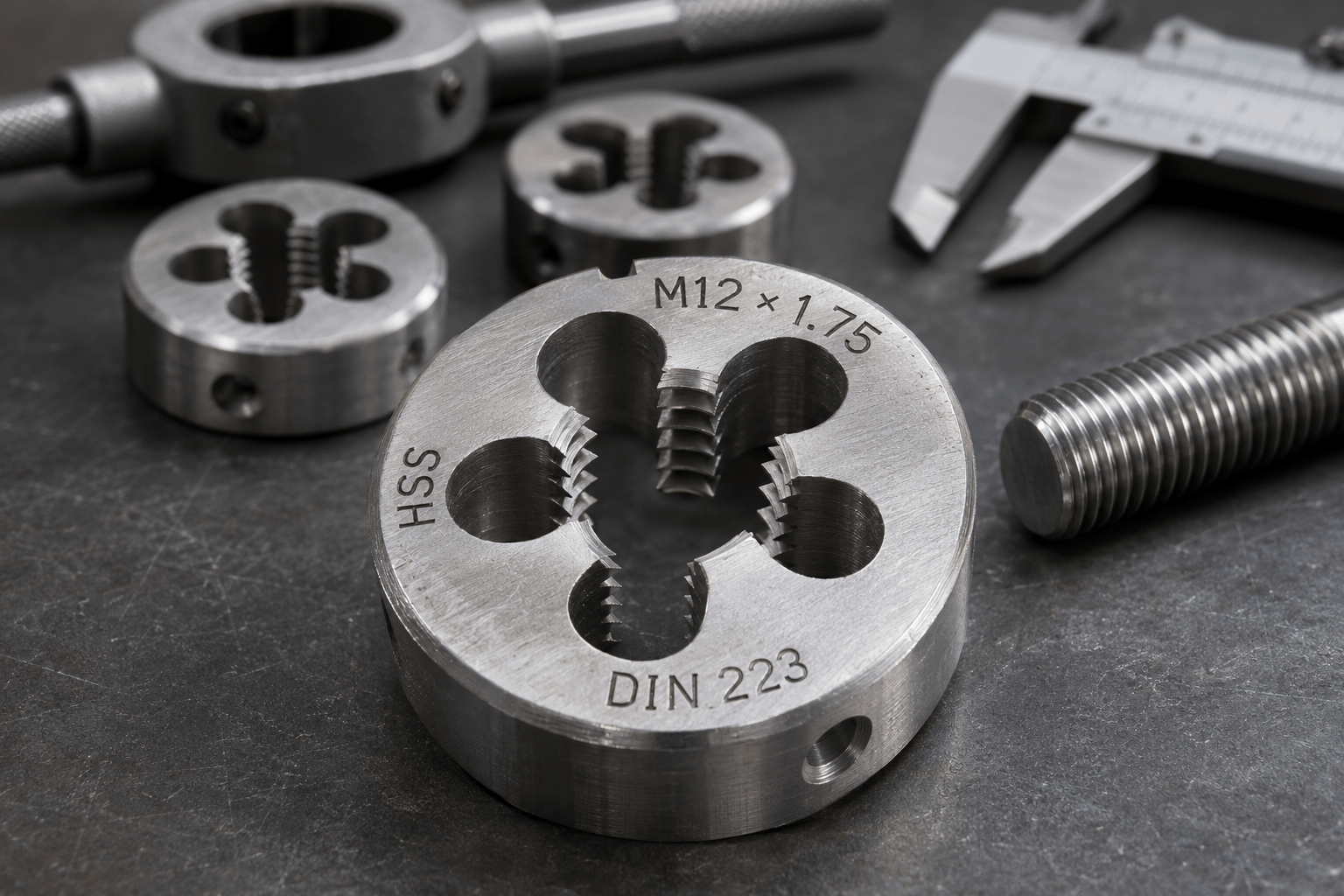
Threading dies are widely used to produce external threads on metal rods, bolts, shafts, and other cylindrical components. However, when purchasing or using threading dies, many buyers encounter different markings, numbers, and technical codes engraved on the tool.
These markings provide important information about thread size, pitch, standard, material, and product specifications. Understanding them helps machinists select compatible tools and enables distributors to identify products more accurately.
In this guide, we will explain how to read threading die markings, understand common thread codes, and identify the key specifications that matter when selecting threading dies.
1. What Information Is Marked on a Threading Die?
Most threading dies have several markings engraved or stamped on their surfaces. Although the exact information varies by manufacturer, common markings include:
- Thread size and nominal diameter
- Thread pitch or threads per inch
- Thread standard
- Material designation
- Tolerance or accuracy class
- Manufacturer identification
For example, a threading die marked M10 × 1.5 HSS provides several pieces of useful information.
- M10 indicates a metric thread with a nominal diameter of 10 mm.
- 1.5 indicates a thread pitch of 1.5 mm.
- HSS indicates that the die is manufactured from high-speed steel.
Reading these markings correctly helps prevent purchasing errors and ensures compatibility with the intended workpiece.
2. How to Read Metric Thread Markings
Metric threads are commonly identified by the letter M followed by a nominal diameter and, when specified, a thread pitch.
For example:
M8 × 1.25
This marking means:
- M: Metric thread
- 8: Nominal diameter of 8 mm
- 1.25: Thread pitch of 1.25 mm
The thread pitch represents the distance between two adjacent thread crests, measured in millimeters.
Some metric threading dies are marked only with the nominal diameter when they use the standard coarse pitch for that size.
However, fine-pitch metric threads have smaller distances between thread crests and must be identified correctly.
Common metric threading die sizes include M4, M5, M6, M8, M10, M12, and M16.
When selecting a metric die, always confirm both the diameter and pitch, especially when working with fine-thread applications.
3. Understanding Inch Thread Markings
Inch-based thread systems are widely used in the United States and several other international markets.
Unlike metric threads, inch threads are generally specified by nominal diameter and threads per inch (TPI).
Two common systems are UNC and UNF.
UNC – Unified National Coarse
UNC threads have a relatively coarse pitch and are commonly used in general mechanical fastening applications.
For example, 1/4-20 UNC means:
- 1/4 inch: Nominal thread diameter
- 20: 20 threads per inch
- UNC: Unified National Coarse thread
UNF – Unified National Fine
UNF threads have more threads per inch than corresponding UNC threads.
For example, 1/4-28 UNF indicates a 1/4-inch nominal diameter with 28 threads per inch.
Fine threads are used in applications where a smaller thread pitch or specific fastening characteristics are required.
Before ordering inch threading dies, buyers should confirm the complete thread designation rather than relying on diameter alone.
4. How to Identify Pipe Thread Die Markings
Pipe threading dies are designed for producing external threads on pipes and fittings. Their specifications differ from ordinary metric and unified threads.
Two widely used pipe thread systems are BSP and NPT.
BSP Threads
British Standard Pipe threads are commonly used in industrial piping, plumbing, and fluid connection systems.
Common designations include:
- BSPT: British Standard Pipe Taper
- BSPP: British Standard Pipe Parallel
BSPT threads are tapered, while BSPP threads are parallel.
NPT Threads
National Pipe Taper threads are widely used in North American piping systems.
Common sizes include 1/8 NPT, 1/4 NPT, 3/8 NPT, 1/2 NPT, and 3/4 NPT.
NPT threads use a tapered design and are different from BSP threads in their geometry and specifications.
Although some pipe thread sizes appear similar, BSP and NPT are not interchangeable. Selecting the correct standard is essential for achieving compatible connections.
5. Understanding Material and Quality Markings
In addition to thread specifications, threading dies may carry markings indicating their material or manufacturing characteristics.
HSS
HSS stands for High-Speed Steel. It is one of the most commonly used materials for threading dies because of its hardness, toughness, and wear resistance.
M35
M35 is a cobalt-containing high-speed steel grade. It offers improved hot hardness and wear resistance compared with many conventional HSS grades.
It may be selected for more demanding cutting applications.
Tolerance Class
Some threading dies also include tolerance or accuracy markings.
These indicate the dimensional requirements of the finished thread according to the relevant standard.
For industrial buyers, tolerance information is particularly important when the threaded component must fit precisely with a matching nut or fitting.
It is important to distinguish between material markings, product standards, and thread tolerance designations because they describe different characteristics of the tool.
6. Common Mistakes When Identifying Threading Dies
Incorrectly reading threading die markings can lead to incompatible products and unnecessary purchasing costs.
Here are several common mistakes to avoid:
Confusing Diameter with Pitch
Two dies may have the same nominal diameter but different pitches. For example, M10 × 1.5 and M10 × 1.25 are different thread specifications.
Mixing Metric and Inch Threads
Metric and inch thread systems use different measurement methods. Always check the complete designation before selecting a tool.
Confusing UNC and UNF
Both systems use inch measurements, but their thread pitches differ. They cannot be treated as interchangeable.
Mixing BSP and NPT
These pipe thread systems have different thread profiles and specifications. Choosing the wrong type may result in connection problems.
Ignoring Material Information
The same thread specification can be available in different tool materials. Buyers should check the material grade according to their machining requirements.
7. What Should Distributors Check Before Ordering?
For wholesalers, hardware distributors, and industrial purchasing companies, accurate product identification is important for inventory management and customer satisfaction.
Before placing an order, consider confirming:
- Complete thread designation and nominal size
- Metric or inch measurement system
- Thread pitch or TPI
- Applicable thread standard
- Required material grade
- Product dimensions and packaging
- Quantity and customization requirements
It is also useful to request product catalogs, technical specifications, or sample products from the supplier before purchasing larger quantities.
A clear specification list helps reduce communication errors and makes repeat purchasing more efficient.
Conclusion
Understanding threading die markings is essential for selecting the correct tools and avoiding thread compatibility problems. From metric and unified thread codes to BSP and NPT pipe specifications, every marking provides useful information about the product.
Whether you are a machinist, hardware distributor, or industrial buyer, learning how to identify threading die specifications can make product selection and procurement more accurate.
TAPMEC supplies threading tools in various sizes and thread standards for international distributors, wholesalers, and industrial customers. Contact us for product specifications, catalogs, and customized sourcing solutions.


