
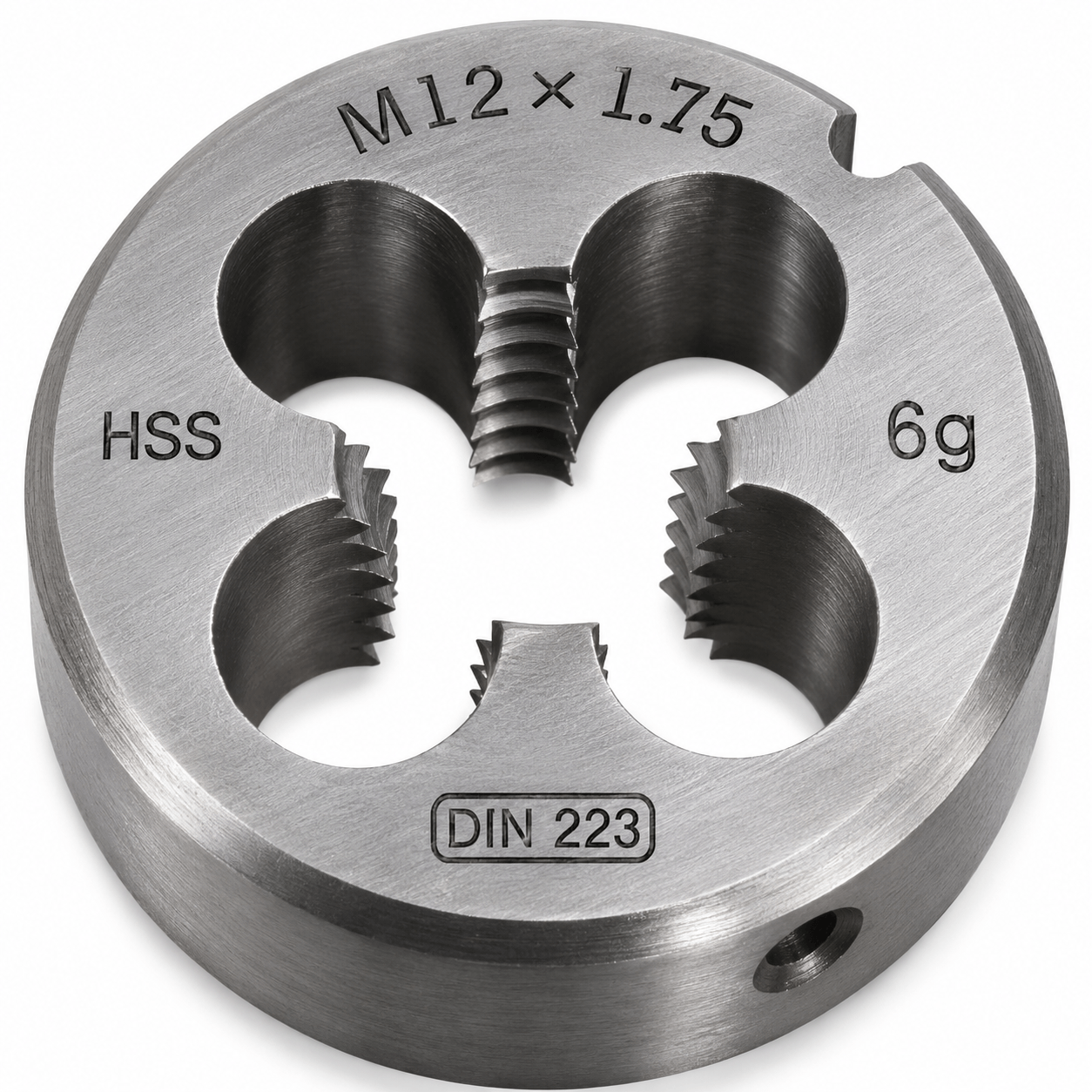
Threading dies are essential cutting tools used to create external threads on metal rods, pipes, bolts, and other cylindrical workpieces. They play an important role in mechanical manufacturing, metalworking, automotive production, equipment maintenance, and general industrial applications.
Whether you are a professional machinist, a hardware distributor, or an industrial tool buyer, understanding threading dies can help you select the right product, improve machining efficiency, and achieve consistent thread quality.
In this guide, we will introduce the main types of threading dies, their materials, common applications, and important factors to consider when purchasing them.
1. What Is a Threading Die?
A threading die is a cutting tool designed to produce external threads on a workpiece. It contains specially designed cutting teeth that gradually remove material from the outside surface of a cylindrical component to form a precise thread profile.
Threading dies are commonly used to manufacture or repair threads on:
- Metal rods and shafts
- Bolts and threaded fasteners
- Pipes and fittings
- Studs and other mechanical components
Compared with some other threading methods, die cutting provides a practical and economical solution for producing external threads, particularly in maintenance workshops, small-batch production, and general machining operations.
2. Different Types of Threading Dies
Threading dies are available in several designs to meet different machining requirements.
Round Dies
Round dies are among the most widely used threading tools. They feature a circular body with internal cutting teeth and are commonly installed in a die stock or compatible threading holder.
They are suitable for cutting external threads on rods, bolts, and other cylindrical workpieces. Round dies are available in various thread standards, sizes, and materials.
Adjustable Dies
Adjustable dies feature a split design that allows users to make minor adjustments to the cutting diameter.
This design provides greater flexibility when producing threads with different tolerances or when performing thread repair work. Adjustable dies are particularly useful in maintenance and general-purpose machining applications.
Hexagon Dies
Hexagon dies have a six-sided external shape and are designed to work with compatible wrenches or holders.
They are especially useful for repairing damaged external threads in restricted spaces where conventional die stocks may be difficult to operate.
Split Dies
Split dies have a small opening in their body, allowing limited adjustment of the cutting diameter.
They are commonly used when flexibility is required during thread cutting. Depending on the design, the opening can help users adjust thread fit and accommodate different machining conditions.
3. Common Materials Used in Threading Dies
Material selection directly affects tool hardness, wear resistance, cutting performance, and service life.
High-Speed Steel (HSS)
High-speed steel is one of the most common materials used for manufacturing threading dies.
HSS offers a good combination of hardness, toughness, and wear resistance. It is suitable for cutting threads in various common metals, including carbon steel and certain alloy steels.
For general industrial applications, HSS threading dies provide a practical balance between performance and cost.
Alloy Tool Steel
Alloy tool steel is another material used in threading tool production. Its mechanical properties can be adjusted through appropriate heat treatment.
Depending on the material grade and manufacturing process, alloy tool steel dies can be suitable for general-purpose threading and maintenance applications.
Cobalt High-Speed Steel
Cobalt-containing high-speed steel, such as M35, provides improved hot hardness and wear resistance compared with many conventional HSS grades.
It can be considered for more demanding machining conditions, particularly when processing tougher materials.
The appropriate material should always be selected according to the workpiece material, cutting conditions, and required production performance.
4. Common Thread Standards for Threading Dies
Threading dies are manufactured according to different international thread standards. Selecting the correct standard is essential for ensuring compatibility with mating components.
Some commonly used thread standards include:
- Metric Thread (ISO): Widely used in international machinery manufacturing. Common sizes include M3, M4, M6, M8, M10, and M12.
- Unified Thread (UNC/UNF): Commonly used in the United States and other markets. UNC represents Unified Coarse threads, while UNF represents Unified Fine threads.
- British Standard Pipe (BSP): Frequently used for pipe connections in various industrial and plumbing applications.
- National Pipe Thread (NPT): A tapered pipe thread standard commonly used in North America for threaded pipe connections.
Before purchasing a threading die, buyers should confirm the thread standard, nominal diameter, pitch, and thread direction.
5. How to Choose the Right Threading Die
Choosing the correct threading die involves more than simply selecting a diameter. Several technical factors should be considered.
1. Workpiece Material
Different metals require different cutting performance. Consider whether you will be threading carbon steel, stainless steel, aluminum, brass, or other materials.
2. Thread Specification
Confirm the required thread standard, nominal size, pitch, and tolerance. An incorrect specification may result in incompatible threads.
3. Die Material
HSS is suitable for many general-purpose applications, while cobalt HSS may be preferable for more demanding cutting conditions.
4. Application and Cutting Method
Determine whether the die will be used for manual threading, maintenance, or machine-assisted operations. The die design and holder must match the intended application.
5. Product Quality and Manufacturing Consistency
Pay attention to cutting tooth geometry, heat treatment, dimensional accuracy, surface finish, and overall manufacturing quality.
For distributors and industrial buyers, consistent product quality across different batches is also important.
6. Tips for Using and Maintaining Threading Dies
Proper operation and maintenance can help extend tool life and improve thread quality.
- Prepare the workpiece: Ensure that the rod diameter is appropriate for the required thread specification. Chamfering the end can make initial cutting easier.
- Use cutting lubricant: Apply suitable cutting oil to reduce friction, heat generation, and cutting resistance.
- Maintain proper alignment: Keep the die perpendicular to the workpiece during initial engagement to avoid producing crooked threads.
- Clear metal chips: Periodically reverse the cutting direction when appropriate to break and remove chips.
- Inspect cutting teeth: Check for wear, chipping, or damage before use.
- Store correctly: Clean the die after use and keep it in a dry, organized storage environment to prevent corrosion and physical damage.
Following these practices helps achieve cleaner threads and more stable machining results.
7. Why Choose a Reliable Threading Die Supplier?
For industrial distributors, wholesalers, and manufacturing companies, choosing a reliable threading die supplier is essential for maintaining product quality and supply stability.
A professional supplier should be able to provide:
- Multiple thread standards and specifications
- Reliable material and heat treatment options
- Consistent dimensional accuracy
- Competitive pricing for wholesale orders
- Low minimum order quantities for product testing
- OEM and customized product solutions
- Stable production capacity and delivery arrangements
Working with a supplier that understands different market requirements can also help buyers expand their product ranges and serve more customers.
Conclusion
Threading dies are important tools for producing and repairing external threads across a wide range of industrial applications. Understanding their different types, materials, thread standards, and operating requirements makes it easier to select the right tool for each machining task.
Whether you need standard metric dies, UNC/UNF threading dies, or customized threading solutions, choosing the right specifications and a dependable supplier is essential for achieving consistent results.
TAPMEC is focused on providing practical threading tool solutions for international buyers. We welcome inquiries from distributors, wholesalers, and industrial customers looking for competitive threading tools, flexible order quantities, and customized product options.
Contact TAPMEC to discuss your threading die requirements and sourcing needs.


