
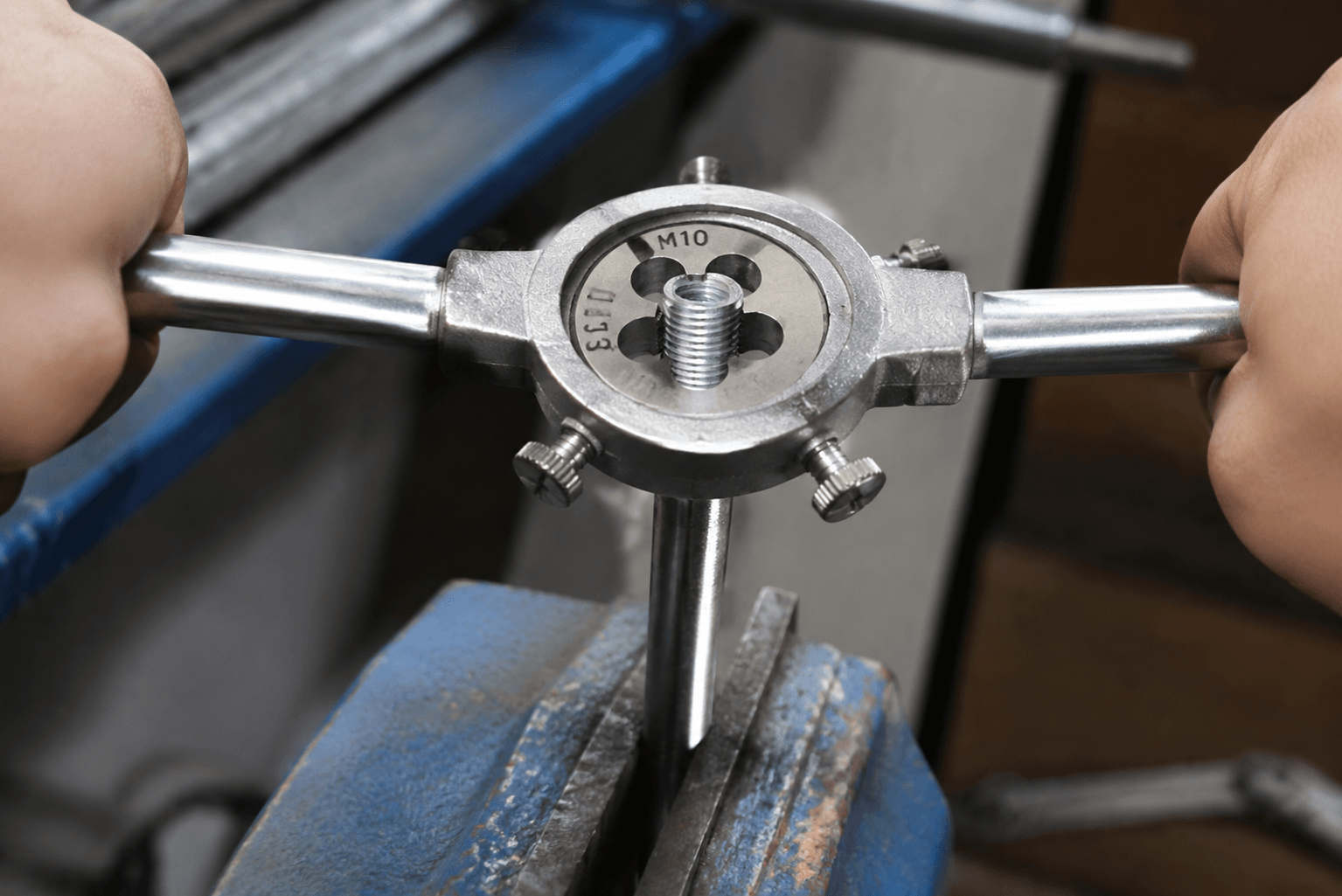
Threading dies are widely used in metalworking and mechanical manufacturing to produce external threads on cylindrical workpieces. From bolts and threaded rods to pipes and industrial components, these tools provide an efficient solution for creating accurate threads in different production environments.
For machinists, manufacturers, and industrial tool distributors, understanding how threading dies work is important for achieving consistent machining results and selecting suitable tools.
In this article, we will explore the working principles of threading dies, their main applications, common threading problems, and practical tips for improving cutting performance.
1. How Do Threading Dies Work?
A threading die is a cutting tool with specially designed internal teeth that remove material from the outside surface of a cylindrical workpiece to create external threads.
During operation, the die is positioned over the end of a metal rod or similar component. As the die rotates around the workpiece, its cutting teeth gradually form the required thread profile.
The basic threading process involves several steps:
Step 1: Prepare the Workpiece
Select a metal rod with an appropriate diameter according to the required thread specification. The end of the rod should be chamfered to help the die engage smoothly.
Step 2: Position the Die
Install the threading die into a compatible die stock or holder. Align the die perpendicular to the workpiece to ensure accurate thread cutting.
Step 3: Begin Thread Cutting
Apply suitable cutting lubricant and rotate the die in the correct direction. Maintain steady pressure while allowing the cutting teeth to remove material gradually.
Step 4: Remove Metal Chips
Periodically reverse the rotation when necessary to break chips and prevent them from accumulating inside the cutting area.
Step 5: Inspect the Finished Thread
After cutting, remove the die and check the thread dimensions, surface condition, and fit with a corresponding nut or thread gauge.
Following these steps helps produce cleaner threads and reduces the risk of damaging the cutting tool.
2. Main Applications of Threading Dies
Threading dies are used across many industries because external threads are essential for connecting, fastening, and assembling mechanical components.
Mechanical Manufacturing
In mechanical manufacturing, threading dies are used to produce threads on metal rods, shafts, bolts, and other machine components. They are particularly useful for small-batch production, component repair, and general machining operations.
Automotive Industry
Automotive manufacturing involves numerous threaded components, including fasteners, mounting studs, and mechanical connections. Threading dies can be used to produce or repair external threads on compatible components.
Plumbing and Pipe Installation
Threading dies are commonly used to create external threads on metal pipes and fittings. Depending on the application, different standards such as BSP and NPT may be required to ensure proper connections.
Equipment Maintenance
During equipment maintenance, existing threads may become worn, damaged, or deformed. Threading dies can help restore external threads and extend the service life of certain mechanical components.
Hardware Production
Manufacturers producing bolts, studs, and other threaded fasteners may use threading dies in suitable production processes, particularly for specialized or low-volume requirements.
3. Common Problems When Using Threading Dies
Even when the correct threading die is selected, improper operation can affect thread quality and tool life.
Here are some common problems and their possible solutions.
Incorrect Thread Dimensions
Threads that are too tight or too loose may result from incorrect workpiece dimensions, improper die adjustment, or selecting the wrong thread specification.
Solution: Check the rod diameter, thread pitch, and applicable standard before machining. Use suitable thread gauges to inspect the finished product.
Rough Thread Surface
Rough or uneven threads can be caused by worn cutting teeth, insufficient lubrication, excessive cutting pressure, or poor chip removal.
Solution: Apply appropriate cutting oil, maintain a steady cutting speed, and inspect the die regularly for wear or damage.
Misaligned Threads
If the die is not positioned perpendicular to the workpiece during initial engagement, the resulting threads may become crooked or uneven.
Solution: Ensure correct alignment before starting the cutting process. Using a suitable die holder can help maintain stability.
Excessive Tool Wear
Continuous cutting, inappropriate material selection, and insufficient lubrication can accelerate cutting-edge wear.
Solution: Select the appropriate die material for the workpiece and machining conditions. Clean and store the tool properly after use.
4. How to Improve Threading Efficiency
Improving threading efficiency involves selecting suitable tools, maintaining proper operating conditions, and following consistent machining procedures.
Consider the following recommendations:
- Choose the correct thread standard: Confirm whether the application requires metric, UNC, UNF, BSP, or NPT threads.
- Select suitable cutting materials: HSS threading dies are commonly used for general applications, while M35 may be considered for more demanding cutting conditions.
- Use proper lubrication: Cutting oil helps reduce friction and heat during machining.
- Maintain tool condition: Regularly inspect cutting teeth and replace damaged or excessively worn dies.
- Control machining alignment: Proper alignment helps prevent uneven threads and unnecessary cutting resistance.
- Use compatible holders: A suitable die stock or machine holder provides better stability during operation.
These practices can help improve thread consistency, reduce unnecessary tool replacement, and support more efficient production.
5. What Should Buyers Consider When Purchasing Threading Dies?
For industrial buyers, wholesalers, and hardware distributors, purchasing threading dies requires attention to several important factors.
Product Specifications
Confirm the required thread diameter, pitch, thread standard, and tolerance. Clear specifications help prevent purchasing errors.
Material and Manufacturing Quality
Ask about the steel grade, heat treatment process, cutting-edge quality, and dimensional accuracy. These factors influence tool performance and service life.
Product Range
A supplier offering different sizes, thread standards, and die designs can make procurement easier and help distributors expand their product categories.
Minimum Order Quantity
For new suppliers or product testing, flexible order quantities can reduce purchasing risks and make it easier to evaluate product quality.
Customization and Supply Capacity
If your business requires special specifications, private labeling, or customized packaging, confirm whether the manufacturer can support these requirements.
Choosing a supplier with stable manufacturing capabilities is important for maintaining consistent product quality and long-term cooperation.
Conclusion
Threading dies remain essential tools in external thread production, equipment maintenance, and general metalworking. Understanding their working principles, applications, and common machining problems can help users improve thread quality and make better purchasing decisions.
Whether you are looking for standard metric threading dies, UNC/UNF dies, or other customized threading solutions, selecting the right specifications and working with a dependable manufacturer are key to achieving reliable results.
TAPMEC provides threading tools for international distributors, wholesalers, and industrial buyers. We welcome inquiries for different specifications, small-batch orders, and customized product requirements.
Contact TAPMEC to discuss your threading tool requirements and explore suitable sourcing solutions.


