
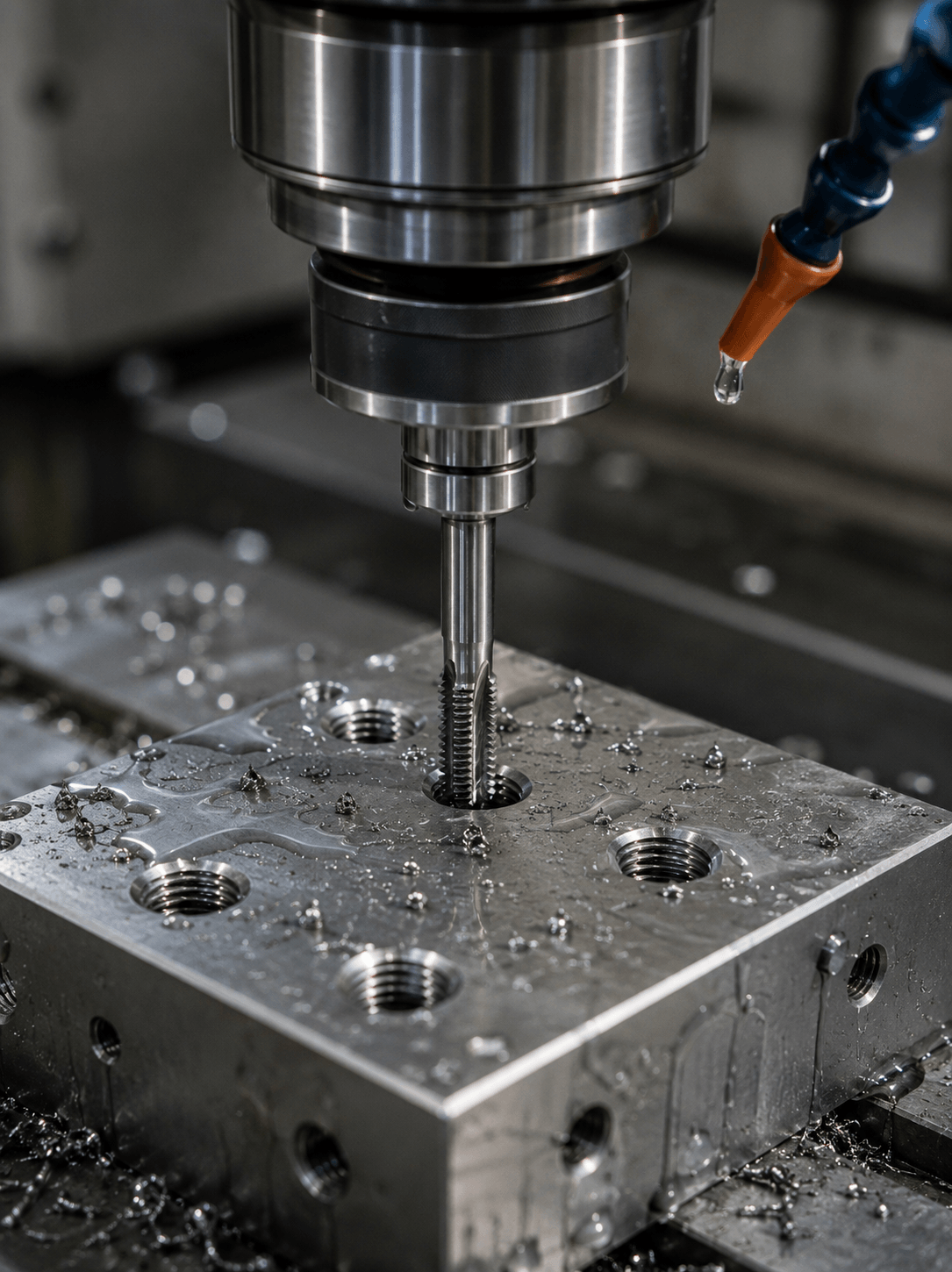
Stainless steel is widely used in food equipment, medical devices, automotive components, chemical systems, and industrial machinery because of its corrosion resistance and strength. However, it is also difficult to tap reliably.
Compared with carbon steel, stainless steel tends to generate more heat, produce long chips, and work-harden under cutting pressure. If the wrong tap, speed, hole size, or lubrication method is used, the result may be high torque, damaged threads, rapid wear, or tap breakage.
This guide explains how to select taps for stainless steel and reduce thread damage during production.
1. Why Stainless Steel Is Difficult to Tap
Stainless steel combines relatively high strength with low thermal conductivity. Heat generated during tapping stays concentrated near the cutting zone instead of moving quickly into the workpiece.
Many grades are also prone to work hardening. If the cutting edge rubs instead of cutting cleanly, the material can become harder locally and make the next cutting pass more difficult.
Austenitic grades such as 304 and 316 are especially common and can be challenging because of their ductility, work-hardening tendency, and long chip formation during tapping.
Typical problems include high torque, long chips, built-up edge, poor thread finish, rapid flank wear, and tap breakage.
2. Choose HSS-Co or PM-HSS
Standard HSS taps can work in some stainless applications, but HSS-Co is often a better choice for production.
Cobalt improves hot hardness and helps the cutting edge maintain strength at elevated temperature. This can provide better wear resistance and more stable tool life.
For demanding applications, powder metallurgy HSS can provide a fine, uniform structure with a useful balance of toughness and wear resistance.
Carbide taps may also be used in rigid, high-precision machines, but they are less tolerant of vibration and misalignment.
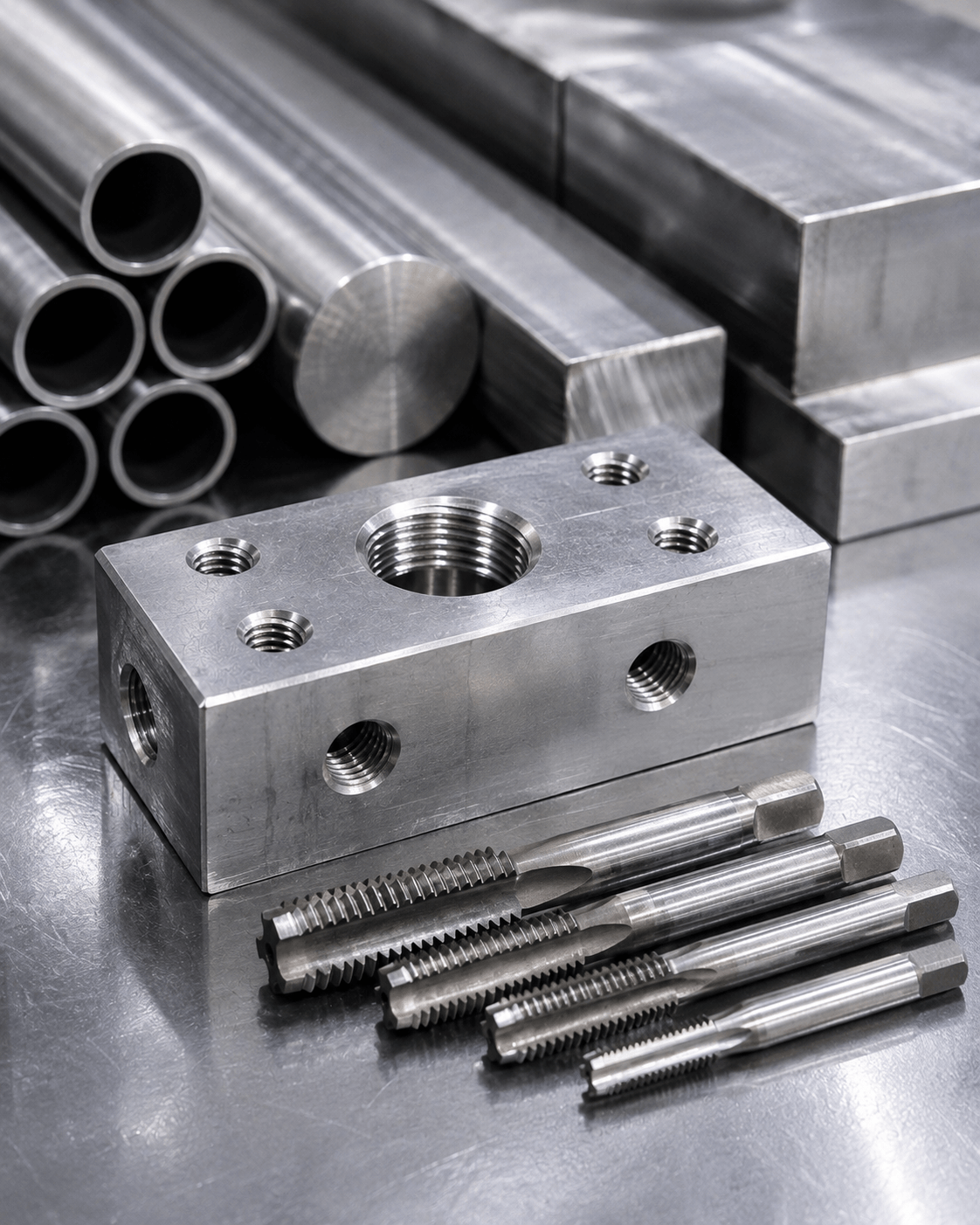
3. Match Tap Geometry to Hole Type
For through holes, spiral point taps are often a good choice because they push chips forward and out of the bottom of the hole.
For blind holes, spiral flute taps are usually preferred because they pull chips backward toward the entrance.
Straight flute taps may work in some conditions, but stainless steel often produces continuous chips, so chip direction is especially important.
Using the wrong geometry can cause chip packing and damage both the tap and the finished thread.
4. Use a Suitable Spiral Angle
Spiral flute taps are available with different helix angles.
A higher spiral angle can improve chip lifting in ductile stainless steel and deeper blind holes. A lower spiral angle may provide stronger cutting edges for tougher conditions.
The ideal geometry depends on stainless grade, hole depth, tap diameter, and machine rigidity. Use a tap designed specifically for stainless steel when possible.
5. Select the Right Coating
Coatings can reduce friction and improve wear resistance.
TiCN is often used where hardness and abrasive wear resistance are important. TiAlN or AlTiN-type coatings can be useful when cutting temperatures are higher.
The best coating depends on tap substrate, coolant, cutting speed, and workpiece grade. A coating cannot compensate for poor geometry or insufficient lubrication.
6. Control the Pre-Drilled Hole Diameter
If the hole is too small, the tap must remove excessive material. Torque increases, chips become larger, and breakage risk rises.
If the hole is too large, thread engagement may be insufficient.
Always verify the actual drilled diameter, especially in high-volume production where drill wear can change hole size over time.
For difficult stainless grades, a slightly larger hole within the allowed specification may reduce tapping torque.
7. Use Effective Lubrication
Stainless steel has a strong tendency to create friction and built-up edge.
Suitable tapping oil or coolant helps reduce friction, heat, and material adhesion while improving thread finish and tool life.
The fluid must reach the cutting zone. In deep blind holes, coolant-thru taps can be useful because they deliver fluid directly to the cutting edges and help evacuate chips.
8. Avoid Excessive Cutting Speed
Running too fast increases heat and can accelerate cutting-edge wear.
Start with the tap manufacturer's recommended speed for the specific stainless grade and tool material.
If torque rises or thread quality deteriorates, reduce speed and inspect lubrication, chip evacuation, and tool wear before continuing production.
9. Control Runout and Alignment
A tap must enter the hole along the correct axis.
Excessive runout causes uneven tooth loading and can enlarge or distort the thread. Misalignment also increases bending forces on the tool.
Use accurate holders, clean collets, rigid workholding, and correct CNC synchronization. Low runout is especially important for small taps and carbide tools.
10. Prevent Work Hardening
Work hardening occurs when the tool rubs against stainless steel instead of cutting efficiently.
Common causes include dull taps, insufficient feed, poor lubrication, and repeated partial cutting.
Use a sharp tap, maintain correct feed synchronization, and avoid unnecessary dwell in the cutting zone.
Replacing a worn tap early is usually cheaper than continuing until the thread or tool fails.
11. Monitor Chips and Tool Wear
Chip shape can provide useful information about the tapping process. Long, tangled chips may indicate unsuitable flute geometry or coolant delivery.
Monitor tool wear by thread count, spindle load, tapping torque, gauge results, and cutting-edge condition.
Do not define tool life only by the moment the tap breaks. Replace the tool when thread quality or torque moves outside the acceptable range.
Conclusion
Successful stainless-steel tapping depends on matching the tap to the material and controlling the complete process.
HSS-Co and PM-HSS taps are often good choices for general production. Spiral point taps suit through holes, while spiral flute taps are usually better for blind holes. Suitable coatings, correct hole diameter, effective lubrication, conservative cutting speed, and low runout all help reduce thread damage.
The goal is stable cutting rather than maximum speed.
By using sharp, application-specific taps and monitoring torque, chips, hole size, and tool wear, manufacturers can reduce thread defects, prevent premature failure, and achieve more consistent tool life when machining stainless steel.


