
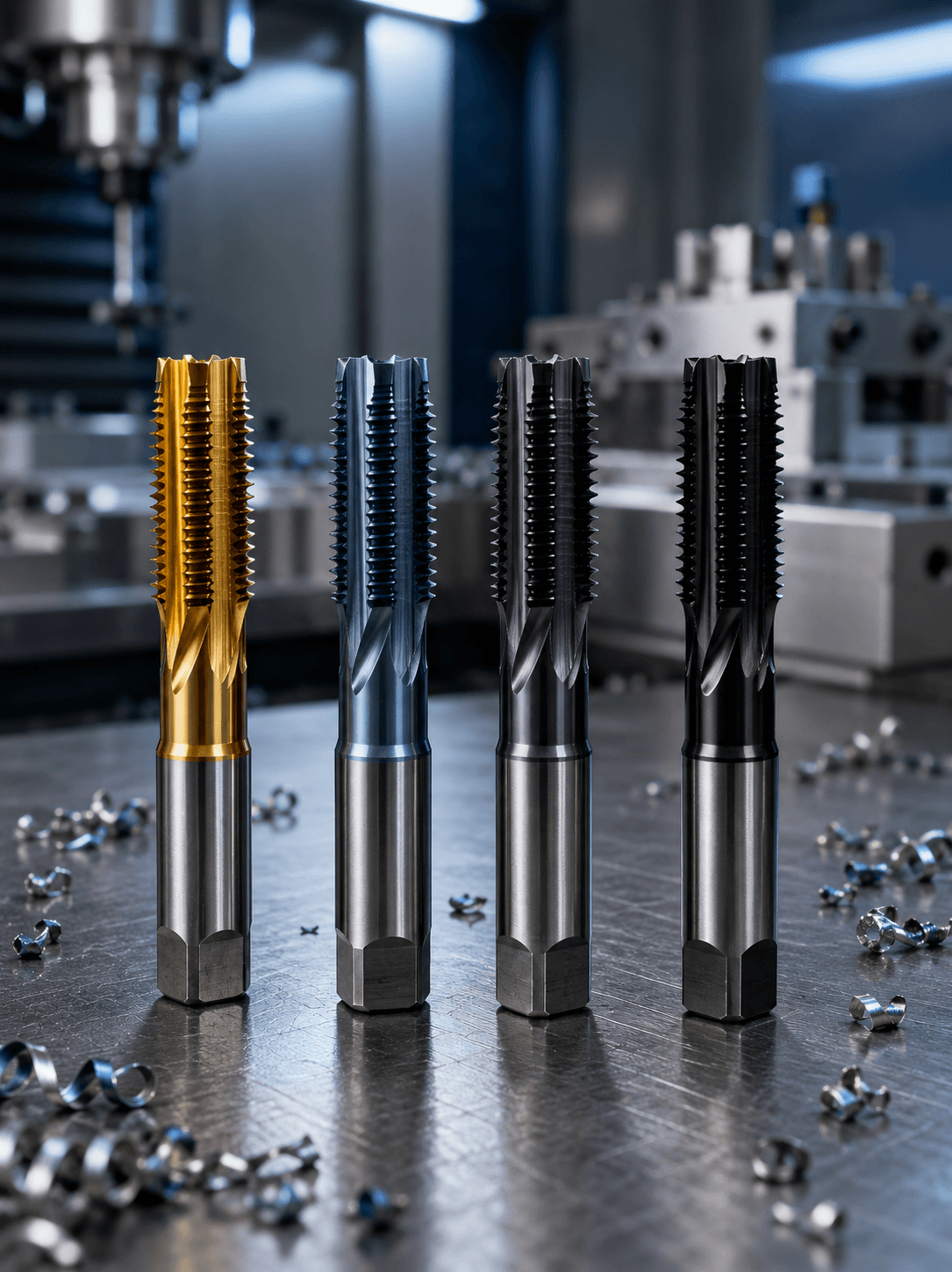
Tap coatings can significantly influence wear resistance, friction, heat management, and tool life. In modern tapping operations, the substrate and cutting geometry remain fundamental, but the right coating can help a tap perform more consistently in demanding materials and high-volume production.
Among the most common options are TiN, TiCN, TiAlN, and DLC. Each has different characteristics, and no single coating is best for every application. The correct choice depends on workpiece material, cutting speed, lubrication, hole type, and machine conditions.
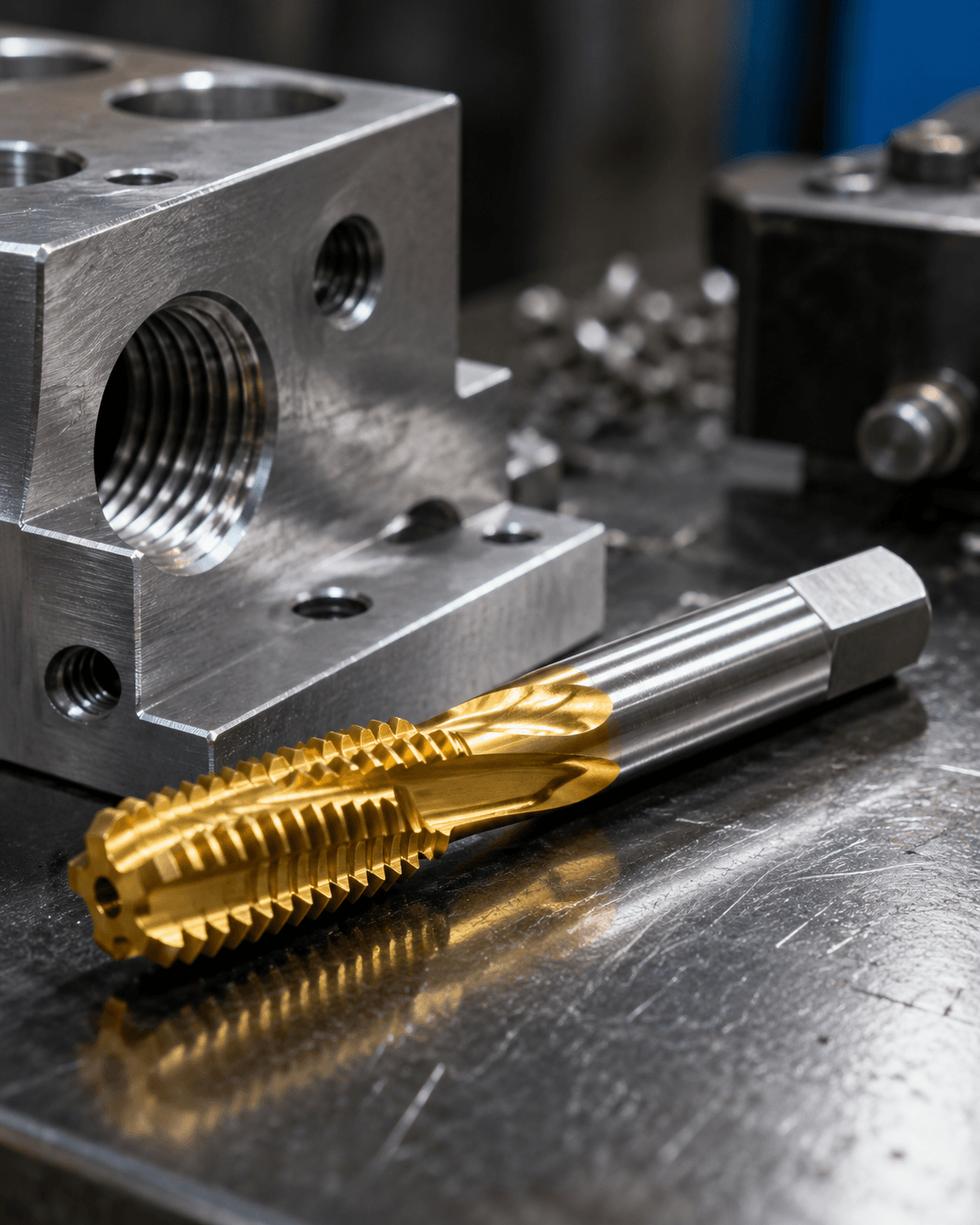
1. Why Are Taps Coated?
During tapping, several cutting teeth are engaged inside a confined hole. Friction, pressure, and chip movement generate heat and gradually wear the cutting edges.
A hard coating creates a protective surface over the tap substrate. Depending on the coating, it may improve wear resistance, reduce friction, limit material adhesion, or help the tool tolerate higher temperatures.
Coatings are very thin, so they do not replace accurate thread grinding, correct heat treatment, or proper cutting geometry. They enhance a correctly manufactured tap rather than compensate for manufacturing defects.
2. TiN: A General-Purpose Coating
Titanium nitride, or TiN, is one of the most widely recognized cutting-tool coatings. Its gold appearance also makes coated tools easy to identify.
TiN provides higher surface hardness than an uncoated HSS substrate and can reduce friction between the tap and workpiece. It is often used for general-purpose tapping in carbon steels, alloy steels, and other common engineering materials.
For users seeking a versatile coating with a good balance of performance and cost, TiN is often a practical starting point. However, it is not always the best choice for very abrasive materials or extremely high cutting temperatures.
3. TiCN: Higher Wear Resistance
Titanium carbonitride, or TiCN, is harder than TiN and is known for strong resistance to abrasive wear.
This makes it useful when taps experience rapid flank wear or when the workpiece is relatively abrasive. TiCN can perform well in steels, alloy steels, cast irons, and some other demanding materials when machining conditions are suitable.
TiCN is often considered when TiN does not provide sufficient wear life but the application does not require the higher-temperature capability associated with TiAlN.
4. TiAlN: Designed for Higher Heat
Titanium aluminum nitride, or TiAlN, is commonly selected for applications where cutting temperatures are higher.
The aluminum content helps the coating maintain useful hardness and oxidation resistance at elevated temperatures. This makes TiAlN attractive for higher-speed cutting and difficult materials where substantial heat is generated.
TiAlN-coated taps may be used in alloy steels, stainless steels, hardened steels, and other demanding applications depending on the tap design.
For high-temperature machining, TiAlN generally offers an advantage over TiN and TiCN.
5. DLC: Low Friction for Non-Ferrous Materials
DLC stands for diamond-like carbon. It differs from the titanium-based coatings above.
DLC coatings are known for very low friction and strong resistance to material adhesion. These characteristics can be especially useful when machining aluminum and other non-ferrous materials that tend to stick to cutting edges.
In aluminum tapping, built-up material can increase torque, damage thread surfaces, and reduce tool life. A low-friction DLC surface can help minimize adhesion and improve chip movement.
DLC is therefore commonly associated with aluminum alloys and other non-ferrous applications rather than high-temperature steel machining.
6. TiN vs. TiCN vs. TiAlN vs. DLC
The four coatings solve different problems.
TiN is a versatile general-purpose option. TiCN emphasizes hardness and abrasive wear resistance. TiAlN is better suited to higher-temperature cutting. DLC focuses on low friction and resistance to material adhesion.
A simple selection guide is:
- TiN: General steels and general-purpose tapping
- TiCN: Abrasive wear and demanding steel applications
- TiAlN: Higher temperatures, alloy steels, stainless steels, and harder materials
- DLC: Aluminum and other non-ferrous materials where adhesion is a major concern
These are general guidelines rather than absolute rules. Tap geometry, substrate, lubricant, and workpiece grade can change the best choice.
7. Coating and Tap Material
The coating works together with the substrate underneath it.
HSS taps provide toughness and are widely used for general threading. HSS-Co provides improved hot hardness for more demanding operations. Carbide offers very high hardness and wear resistance but requires rigid machines and accurate alignment.
Applying an advanced coating to an unsuitable substrate will not automatically create a high-performance tap. Poor runout, vibration, or incorrect geometry can still cause rapid failure.
8. Coating Thickness and Cutting-Edge Sharpness
Tap coatings must be applied with controlled thickness.
If the coating is too thick, it can alter cutting-edge sharpness and influence thread dimensions. This is especially important for small taps and precision threads.
Modern PVD processes are designed to deposit thin, controlled layers while maintaining the underlying geometry.
For aluminum applications, edge sharpness is especially important because a blunt edge encourages material smearing and adhesion.
9. Lubrication Still Matters
A coated tap still needs suitable lubrication.
Coatings can reduce friction, but they cannot eliminate heat or chip-control problems. Cutting fluid helps lower torque, cool the cutting zone, and move chips away from the tool.
This is particularly important in blind holes, stainless steel, and aluminum.
The best performance comes from combining the correct coating with proper lubricant, hole size, cutting speed, and flute geometry.
10. How to Choose the Right Coating
Start with the workpiece material.
For general carbon and alloy steels, TiN or TiCN may be practical choices. For higher-temperature or harder steel applications, TiAlN may provide better thermal resistance. For aluminum and other materials with a strong tendency to adhere to the tool, DLC may be preferable.
Then consider production volume, cutting speed, coolant, hole depth, machine rigidity, and required tool life.
The most expensive coating is not automatically the best coating. The goal is to select the option that provides the lowest overall cost per threaded hole while maintaining thread quality.
Conclusion
TiN, TiCN, TiAlN, and DLC coatings each provide different benefits for tap performance.
TiN is a reliable general-purpose coating, TiCN offers increased hardness and abrasive wear resistance, TiAlN performs well under higher thermal loads, and DLC provides very low friction for aluminum and other non-ferrous materials.
Coating selection should always be matched to the workpiece material, tap substrate, cutting geometry, lubrication, and machining conditions.
When the coating and application are correctly matched, manufacturers can reduce friction and wear, improve thread consistency, extend tap life, and achieve more stable production.


