
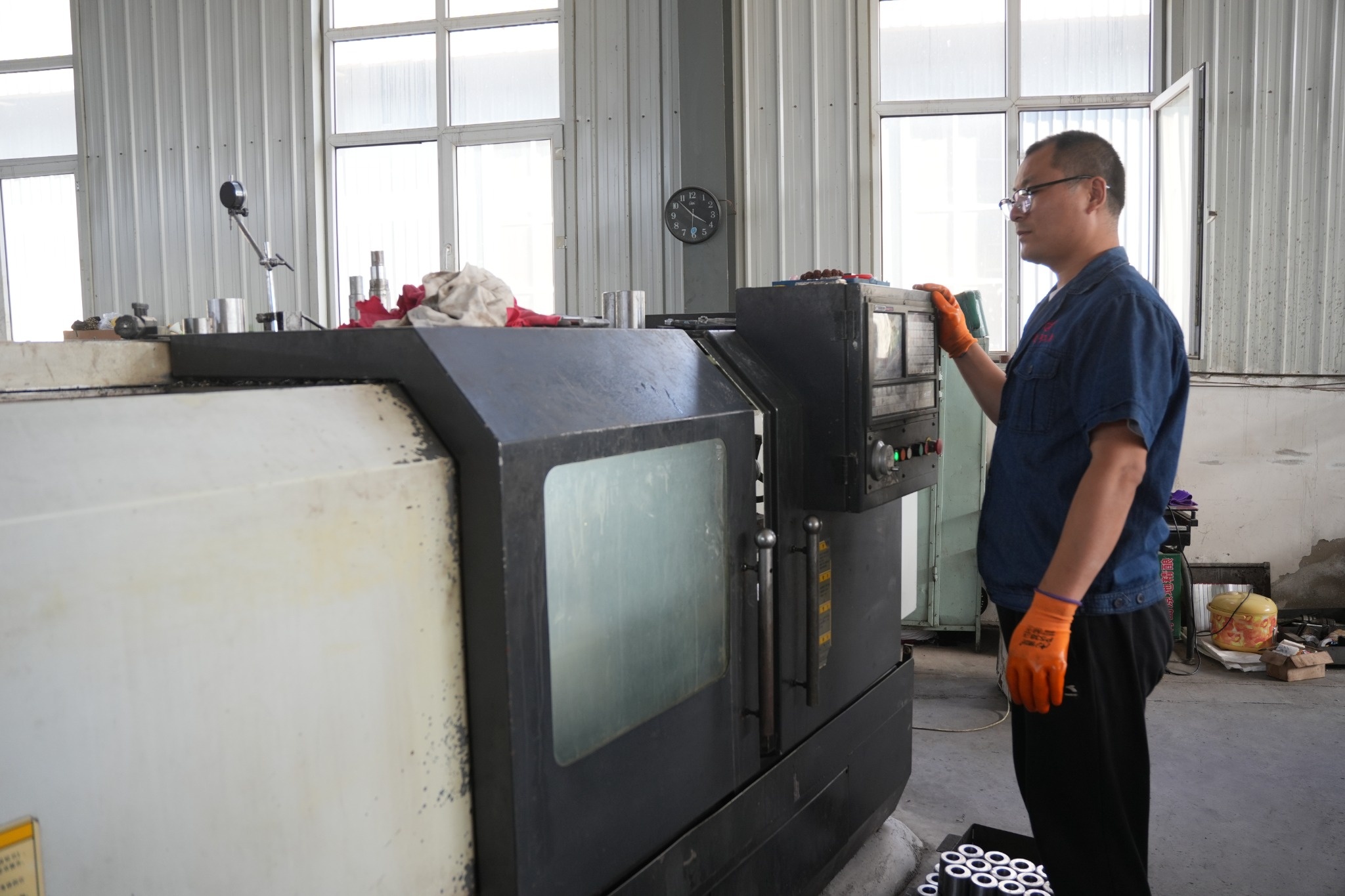
In tap manufacturing, the finished tool depends on a sequence of carefully controlled processes. Before the tap receives its thread profile, flutes, cutting edges, heat treatment, and coating, the raw material must first be converted into an accurately shaped blank. One of the most important machines used at this early stage is the lathe.
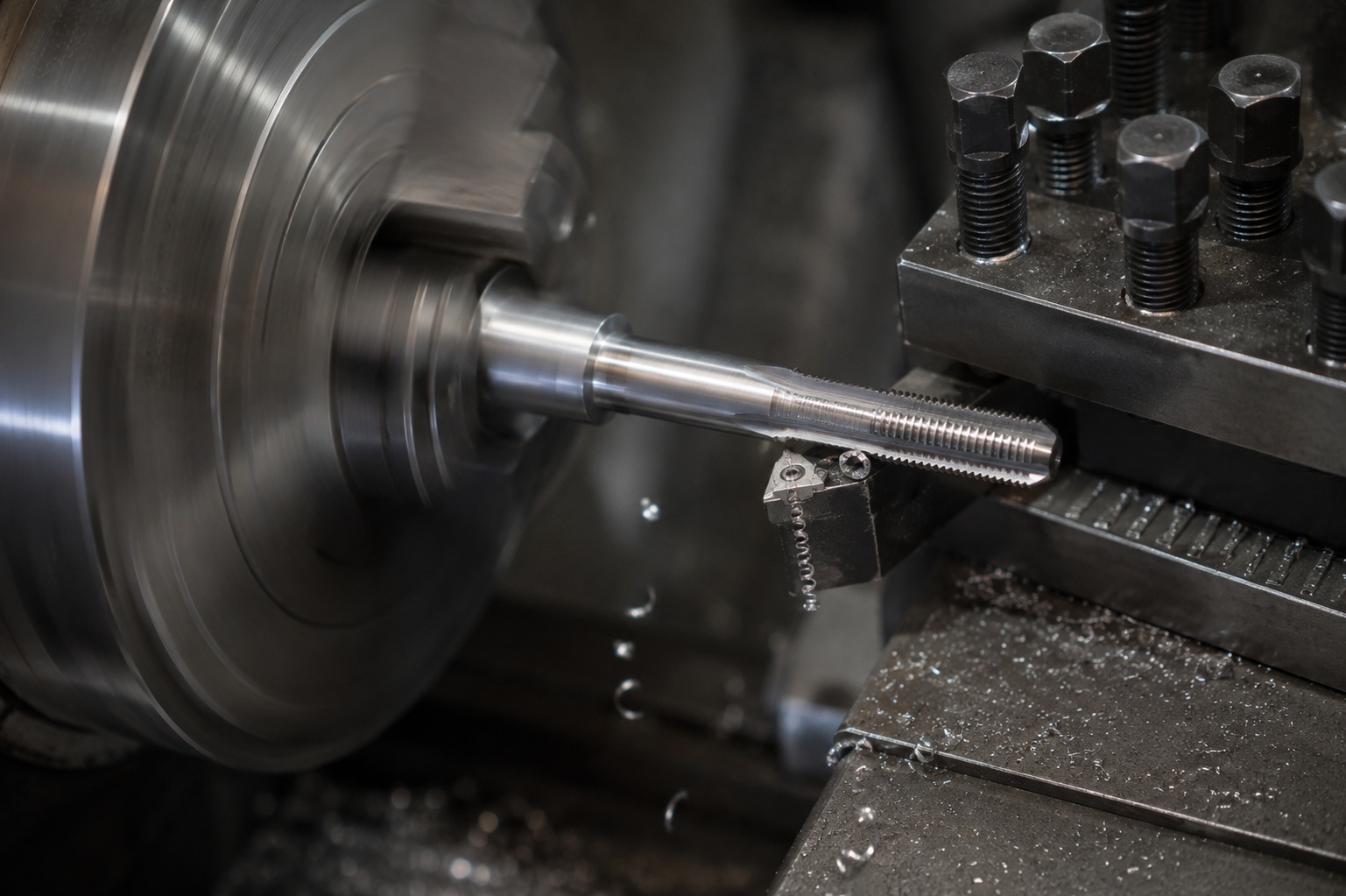
A lathe is mainly used to machine the basic cylindrical geometry of the tap blank. It can turn the outside diameter, shank, neck, end faces, grooves, chamfers, and other rotational features before the blank moves to later operations such as flute machining and thread grinding.
Although turning does not normally create the final precision thread of a ground tap, it establishes the dimensional foundation for later manufacturing stages.
1. Starting from Round Tool Steel
Tap production usually begins with round bar material, commonly high-speed steel or cobalt-alloyed high-speed steel.
The bar is first cut into individual pieces according to the approximate required length. At this stage, each piece is still a simple cylindrical blank.
The lathe removes excess material and creates the main profile of the future tap. A simplified production route may be:
Raw material → Cutting → Turning → Square-end machining → Flute machining → Heat treatment → Thread grinding → Finishing → Inspection
The exact sequence varies between manufacturers, but turning is generally one of the first major machining steps.
2. Facing the Ends
One of the first lathe operations is often facing.
During facing, the cutting tool moves across the end of the rotating blank to create a flat surface perpendicular to the centerline.
This operation helps control the overall length and provides a reliable reference surface for later machining. Accurate end faces also improve positioning during center drilling and grinding.
3. Turning the Main Diameters
The lathe is used to reduce the raw bar to the required diameters for different sections of the tap.
A typical tap blank may contain a thread section, neck, and shank. Each section can require a different diameter.
For taps that will be thread-ground after heat treatment, the thread section is usually not turned directly to its final finished size. A controlled amount of material is left as grinding allowance.
Too little allowance may prevent later grinding from correcting dimensional errors, while too much increases grinding time, wheel wear, and production cost.
4. Preparing the Thread Section
Before the thread profile is produced, the corresponding area of the blank must be turned into an accurate cylindrical surface.
This section provides the base material from which the final thread teeth will later be formed.
Its diameter, straightness, and concentricity are important because large deviations can affect thread grinding.
Good blank preparation allows the grinding machine to remove a predictable amount of material and helps maintain consistent dimensions from one tap to another.
5. Turning the Tap Shank
The shank is the cylindrical section behind the threaded cutting portion.
It provides a holding surface for a tap wrench, tapping chuck, collet, or machine-tool holder. The lathe machines this section to the required diameter and length.
Concentricity between the shank and thread section is especially important. If the shank is eccentric, the finished tap may not rotate accurately when mounted in a machine.
Excessive runout can lead to uneven cutting loads, poor thread quality, and reduced tool life.
6. Machining the Neck
Many taps include a reduced-diameter section between the threaded area and the shank. This section is usually called the neck.
The neck provides clearance and helps prevent unnecessary contact between the tool body and the workpiece.
A lathe can produce this feature efficiently because it is rotationally symmetrical.
The transitions between the thread section, neck, and shank should also be controlled carefully. Proper transitions help provide sufficient clearance for later machining.
7. Grooves and Chamfers
The lathe can also produce smaller features on the tap blank, including relief grooves, grinding run-out areas, chamfers, and simple tapered sections.
A relief groove can provide space for a grinding wheel to exit the thread section without damaging an adjacent surface.
Chamfers remove sharp edges and make handling easier. In some production routes, the front of the blank may also receive preliminary shaping before the final cutting chamfer is produced during grinding.
8. Center Drilling for Grinding
Some tap manufacturing processes support the blank between centers during cylindrical or thread grinding.
In these cases, center holes are produced at the ends of the tap blank.
These holes provide locating points and help the blank rotate around a consistent centerline during precision grinding.
Correctly positioned center holes can improve concentricity, while poorly located holes may cause eccentric rotation and make final dimensions more difficult to control.
9. Why Concentricity Matters
Concentricity is one of the most important quality requirements during turning.
The thread section, neck, and shank should share the same central axis as closely as possible.
If the blank is poorly turned, later grinding may need to remove excessive material to correct the error. In severe cases, the blank may need to be rejected.
Good turning helps reduce runout, uneven grinding, dimensional variation, scrap, and unnecessary production time.
Accurate workholding, machine alignment, tool condition, and cutting parameters all contribute to better concentricity.
10. Conventional and CNC Lathes
Both conventional and CNC lathes can be used in tap production.
Traditional factories may use manually operated lathes for small batches or standard tap sizes. These machines are flexible, but production consistency depends strongly on operator skill.
CNC lathes provide greater automation and repeatability. They can control diameter, length, feed rate, cutting speed, and tool position according to a programmed cycle.
However, good tap blanks still depend on correct setup, machine maintenance, tool condition, and inspection.
11. Cutting Parameters and Inspection
Turning quality is affected by cutting speed, feed rate, depth of cut, tool geometry, coolant, workpiece material, and machine rigidity.
Incorrect settings can cause vibration, rough surfaces, dimensional errors, or excessive tool wear.
After turning, the tap blank is normally inspected before moving to more expensive stages. Typical checks include overall length, thread-section diameter, shank diameter, neck diameter, concentricity, end-face condition, center-hole position, and surface quality.
Detecting problems at this stage prevents defective blanks from continuing into heat treatment and precision grinding.
12. What the Lathe Does Not Normally Produce
The lathe creates the basic tap blank, but it does not normally produce the final precision cutting geometry of a ground tap.
Operations such as final thread grinding, spiral flute grinding, spiral point geometry, relief grinding, and final cutting-edge preparation require other specialized machines.
The lathe's role is to establish the correct shape, dimensions, and reference surfaces so these later processes can be completed accurately.
Conclusion
Turning is a fundamental stage in tap manufacturing.
The lathe transforms a simple round steel bar into a properly dimensioned tap blank by machining the thread section, shank, neck, end faces, grooves, chamfers, and other cylindrical features.
Although it does not normally create the final precision thread, turning directly affects the quality and efficiency of later processes.
Accurate diameters, good concentricity, correct grinding allowance, stable surface quality, and reliable positioning make flute machining, heat treatment, and thread grinding more consistent.
For tap manufacturers, the lathe is therefore not simply a machine for removing excess metal. It establishes the geometric foundation from which the finished tap is built.


