
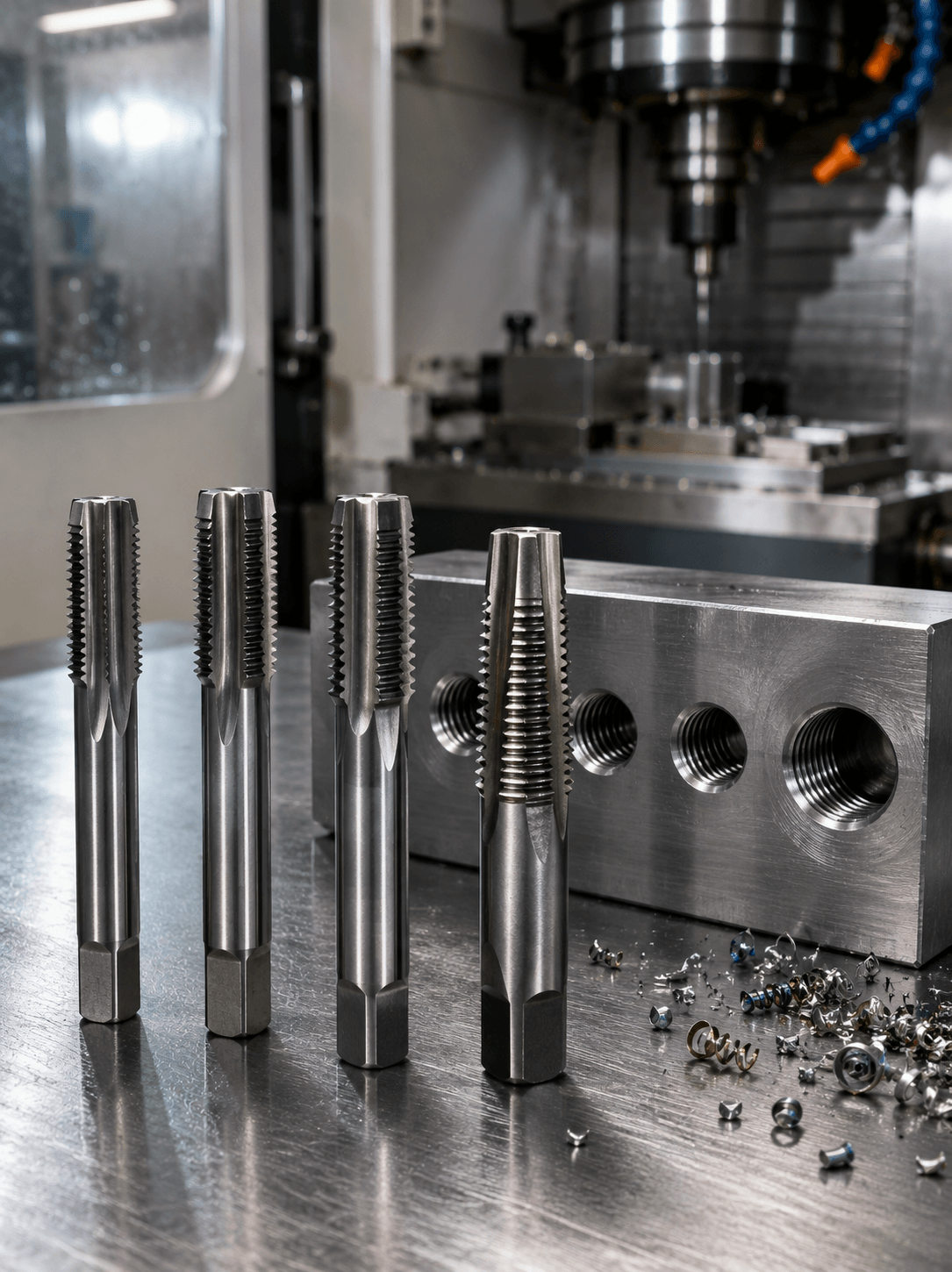
Thread standards define how threaded parts fit, assemble, and seal. For tap users, choosing the correct standard is essential because a tap must match the required thread diameter, pitch, profile, tolerance, and, in some cases, taper.
Metric, UNC/UNF, and NPT are three of the most common thread systems used in manufacturing. Although they may look similar, they are not interchangeable. Using the wrong tap can produce threads that fail gauges, reject the mating fastener, or create sealing problems.
This guide explains the key differences and how to select the correct tap.
1. What Is a Thread Standard?
A thread standard defines the geometry and dimensional rules of a screw thread.
Important parameters include nominal diameter, pitch or threads per inch, thread angle, pitch diameter, tolerance class, and whether the thread is parallel or tapered.
A similar outside diameter does not make two thread systems compatible. The tap must match the exact specification shown on the drawing or customer requirement.
2. Metric Threads
Metric threads are widely used in Europe, Asia, and international manufacturing.
They are identified by the letter M followed by the nominal diameter in millimeters. For example, M8 identifies a metric thread with an 8 mm nominal diameter.
Pitch is also stated in millimeters. M8 × 1.25 means an 8 mm nominal diameter with a 1.25 mm pitch.
ISO metric threads normally use a 60-degree thread angle.
3. Metric Coarse and Fine Threads
Metric threads are available in coarse and fine pitches.
Coarse threads are common in general mechanical assembly because they are easy to use and relatively tolerant of contamination and damage.
Fine threads have a smaller pitch and provide more threads over the same engagement length. They may be selected for finer adjustment, limited wall thickness, or specific design requirements.
The tap must always match the exact pitch. An M10 coarse tap and an M10 × 1.0 fine tap are not interchangeable.
4. UNC and UNF Threads
UNC and UNF belong to the Unified Thread Standard and are widely used in the United States and other inch-based markets.
UNC means Unified National Coarse, while UNF means Unified National Fine.
Pitch is expressed as threads per inch, or TPI.
For example, 1/4-20 UNC means a 1/4-inch nominal diameter with 20 threads per inch. A 1/4-28 UNF thread has the same nominal diameter but 28 threads per inch.
Both use a 60-degree thread form.
5. UNC vs. UNF
UNC threads have a coarser pitch and fewer threads per inch. They are widely used in machinery, structural components, and general fastening.
UNF threads have a finer pitch and more threads per inch. They may be used where finer adjustment, greater thread engagement over a limited length, or a specific mechanical design requires them.
A UNC tap cannot replace a UNF tap of the same nominal diameter because their pitches are different.
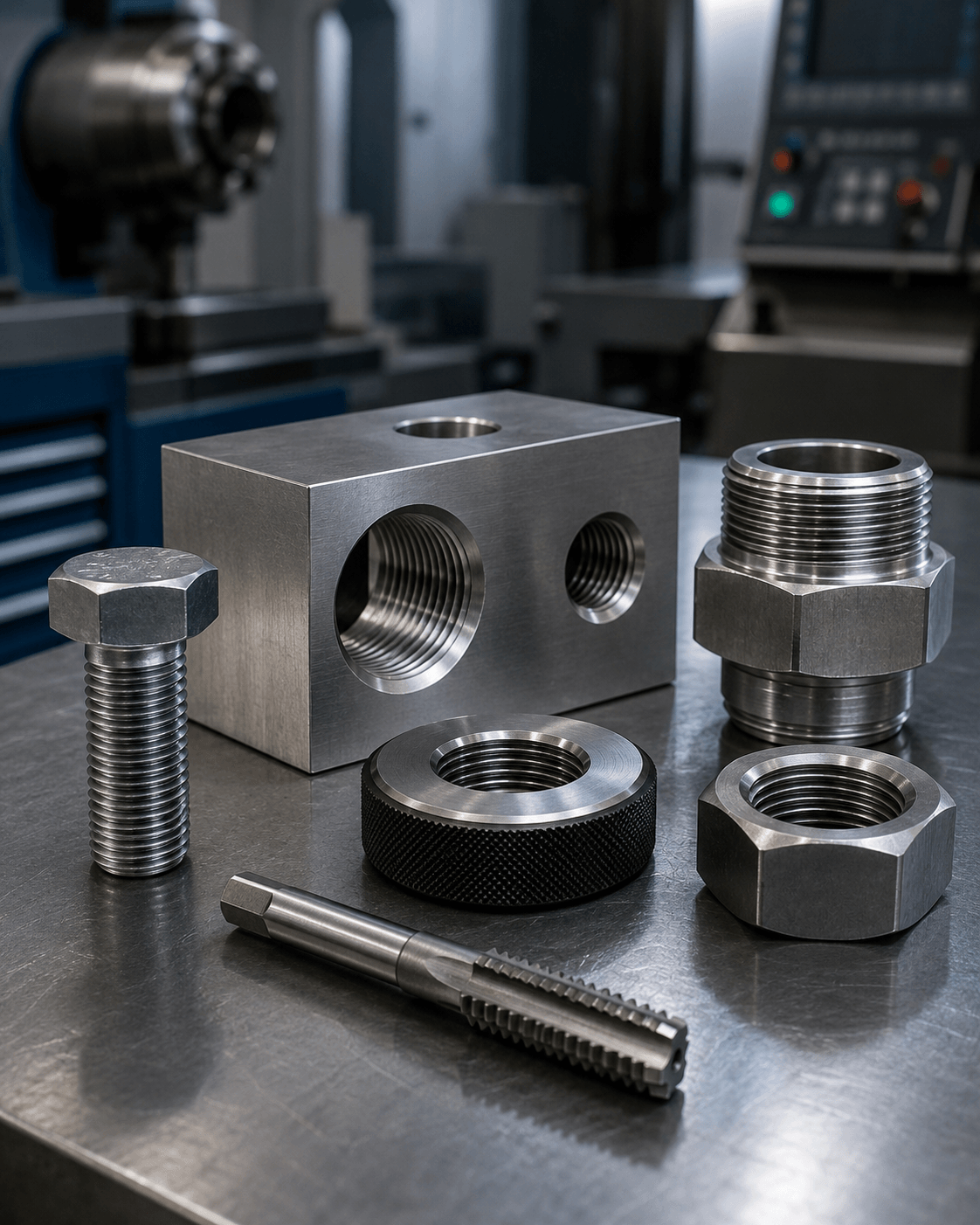
6. Metric vs. UNC/UNF
Metric and Unified threads commonly use the same 60-degree thread angle, but their dimensions are based on different systems.
Metric threads specify pitch in millimeters. UNC and UNF specify pitch in threads per inch.
For example, an M6 thread and a 1/4-inch thread may appear similar in diameter, but their actual dimensions and pitches differ.
Always verify the drawing, fastener specification, or thread gauge before selecting a tap.
7. What Is an NPT Thread?
NPT stands for National Pipe Taper.
It is primarily used for pipe connections carrying liquids, gases, compressed air, and other fluids.
Unlike common Metric, UNC, and UNF fastener threads, NPT threads are tapered. The taper creates increasing interference as the male and female threads are tightened.
NPT uses a 60-degree thread form and a standard taper of 1 in 16 on diameter.
An NPT tap must therefore generate both the correct thread profile and the correct taper.
8. Why NPT Tap Depth Matters
Tap depth is especially important with tapered pipe threads.
With NPT, advancing the tap farther into the hole changes the effective thread diameter at the opening.
If the tap goes too deep, the fitting may screw in too far. If it does not go deep enough, the connection may be too tight or fail gauge inspection.
Manufacturers should therefore control tapping depth carefully and use the correct NPT gauge.
9. NPT Threads and Sealing
NPT is commonly used in valves, pumps, hydraulic equipment, pneumatic systems, pipe fittings, and industrial fluid-control components.
The tapered geometry creates mechanical interference between mating threads. Depending on the application, thread sealant or tape may also be used.
Poor thread form, incorrect taper, or wrong tapping depth can affect assembly and sealing performance.
10. Tap Geometry Is Separate from Thread Standard
Thread standard defines the thread to be produced, but it does not determine the flute style.
A Metric, UNC, UNF, or NPT tap still needs the correct cutting geometry for the hole and material.
Straight flute taps are useful in many general or short-chipping applications. Spiral point taps are commonly used for through holes, while spiral flute taps are often preferred for blind holes.
Tap material, coating, coolant, and cutting parameters must also match the workpiece.
11. Thread Tolerances and Inspection
Each thread system includes tolerance requirements.
Metric internal threads may use classes such as 6H, while Unified internal threads commonly use classes such as 2B or 3B. NPT threads have their own gauging requirements.
Finished threads should be inspected with the appropriate thread plug gauge, GO/NO-GO gauge, or pipe-thread gauge.
A bolt or fitting turning into the hole by hand does not prove that the thread meets specification.
12. How to Choose the Correct Tap
Before ordering a tap, confirm:
- Thread system: Metric, UNC, UNF, or NPT
- Nominal size
- Pitch or TPI
- Required tolerance
- Hole type and thread depth
Then consider the workpiece material, flute geometry, tap substrate, coating, cutting speed, and coolant.
This simple process prevents many common selection errors.
Conclusion
Metric, UNC/UNF, and NPT taps are designed for different thread systems and should never be selected by diameter alone.
Metric threads use millimeter dimensions and pitch. UNC and UNF use inch-based diameters and threads per inch, with UNC representing coarse pitches and UNF finer pitches. NPT is a tapered pipe-thread system used mainly for fluid and pressure connections.
The correct tap must match the exact standard, size, pitch, tolerance, and application.
By verifying these specifications before machining, manufacturers can avoid thread mismatch, gauge failures, assembly problems, and sealing issues while achieving more reliable internal threading performance.


