
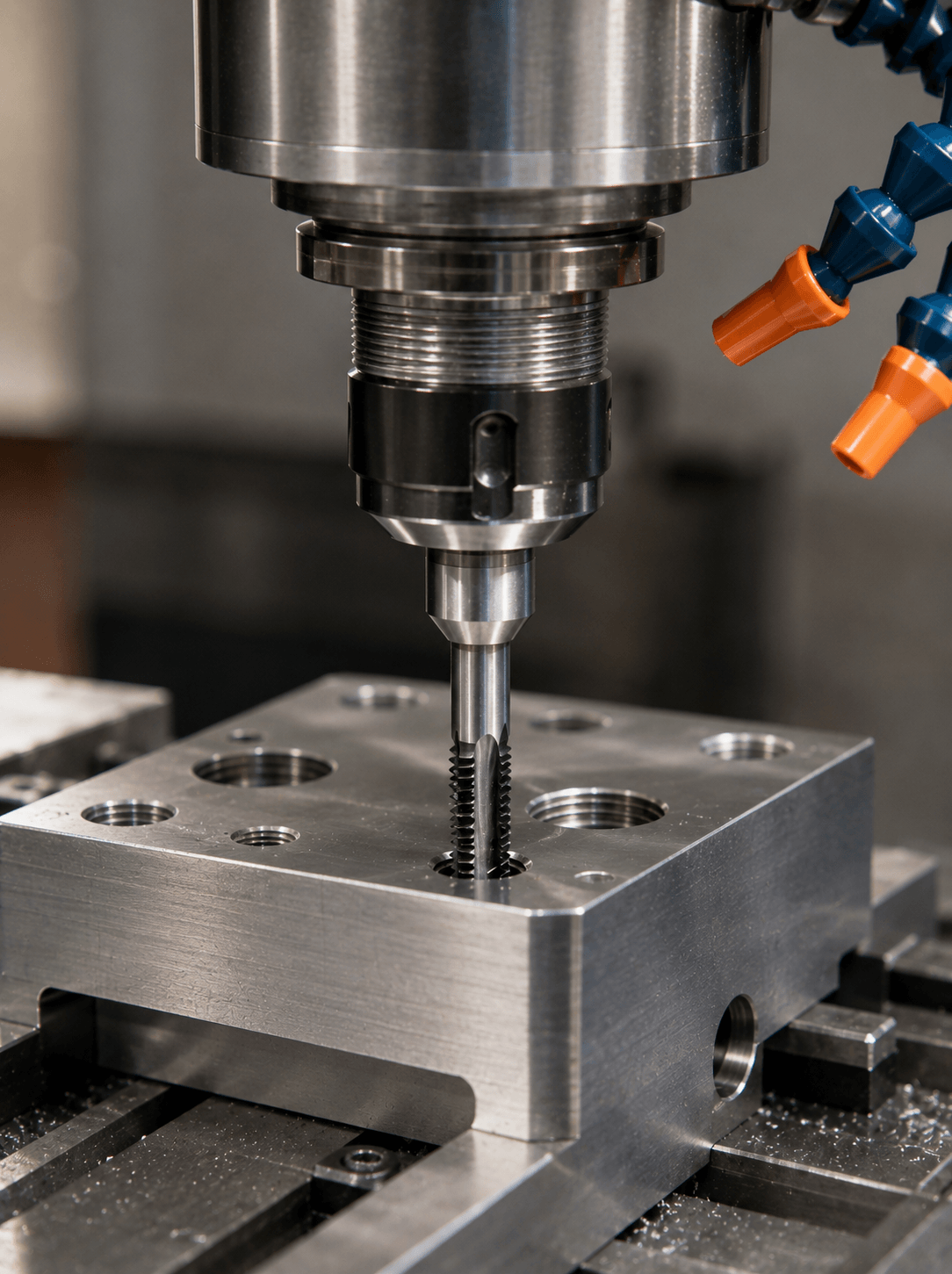
Synchronized high-speed tapping is widely used in CNC machining when manufacturers need faster cycle times, accurate thread quality, and stable tool life. Unlike conventional tapping systems that rely heavily on axial compensation in the holder, synchronized tapping coordinates spindle rotation and machine feed so that the tap advances according to the thread pitch.
Reliable results depend on the tap and tool holder working as a matched system. Tap geometry, holder design, runout, coolant delivery, and CNC synchronization all influence cutting performance.
1. What Is Synchronized Tapping?
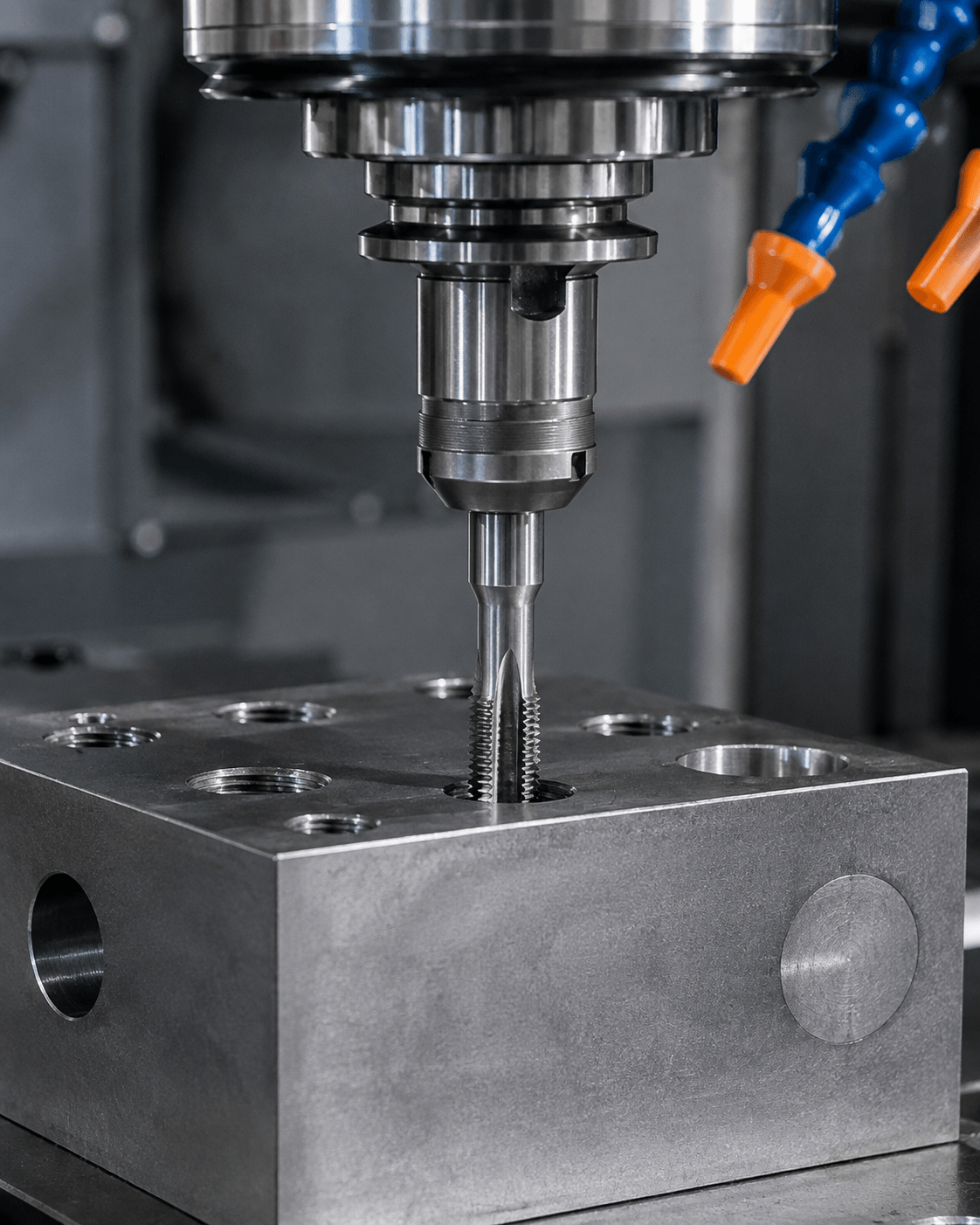
In synchronized, or rigid, tapping, the CNC control matches spindle rotation with axial feed. For a single-start thread, the tap must advance one thread lead for every spindle revolution.
For example, if the thread pitch is 1.5 mm, the machine feed must advance the tap 1.5 mm per spindle revolution.
When synchronization is accurate, the tap follows its thread path with minimal unwanted axial loading.
2. Why High-Speed Tapping Requires Better Control
As tapping speed increases, small process errors become more important.
Feed mismatch, spindle lag, runout, or holder movement can create additional axial and radial loads on the tap. At higher speed, these errors can accelerate wear or cause breakage.
High-speed tapping therefore requires a stable combination of machine control, accurate toolholding, suitable tap geometry, and consistent hole preparation.
3. The Role of the Tap
The tap must match the workpiece material, hole type, and production speed.
For through holes, spiral point taps are commonly used because they push chips forward and reduce chip congestion.
For blind holes, spiral flute taps are generally preferred because they pull chips back toward the hole entrance.
Form taps can also be effective when the workpiece is sufficiently ductile. Because they produce no chips, they remove one major source of process instability.
4. The Role of the Tool Holder
The tool holder transfers spindle torque to the tap and keeps the tool aligned.
In synchronized tapping, the holder should provide low runout, secure clamping, sufficient torque transmission, and minimal unnecessary movement.
Some holders are rigid, while others include a small amount of axial compensation. This limited compensation can absorb minor synchronization errors caused by spindle acceleration or reversal.
The best holder depends on the CNC machine and application.
5. Why Runout Matters
Runout causes the tap to rotate slightly off-center.
This creates uneven loading on the cutting teeth. Some teeth remove more material than others, which can increase torque, accelerate wear, and produce inconsistent threads.
Runout is especially important for small-diameter and carbide taps because they tolerate less side loading.
Clean collets, accurate holders, maintained spindle interfaces, and correct clamping help reduce runout.
6. Feed Synchronization and Thread Pitch
The CNC feed rate must match spindle speed and thread lead.
The relationship is:
Feed rate = Spindle speed × Thread lead
If an M10 × 1.5 tap runs at 1,000 rpm, the theoretical axial feed is 1,500 mm/min.
If feed is too high or too low, the machine can push or pull the tap, creating axial stress and reducing tool life.
Accurate control is particularly important during spindle reversal.
7. Tool Holder Compensation
Traditional tapping holders often use significant tension-compression travel to compensate for machines that cannot synchronize feed and spindle rotation precisely.
Modern synchronized tapping requires much less compensation.
A holder with limited micro-compensation can still absorb small differences caused by servo response, pitch error, or spindle reversal without placing excessive axial force on the tap.
Too much holder movement can reduce the benefits of synchronization.
8. Coolant Delivery and Chip Control
High-speed tapping generates heat quickly.
Effective coolant reduces friction, controls temperature, and helps chips move away from the cutting zone.
For deep holes or difficult materials, coolant-thru taps and compatible holders can deliver fluid directly to the cutting edges, improving lubrication and chip evacuation.
The coolant path must remain sealed through the spindle, holder, and tap.
9. Hole Preparation
Even a good tap and holder cannot compensate for an incorrect pre-drilled hole.
An undersized hole increases tapping torque. An oversized hole can reduce thread engagement.
Hole position and straightness also matter. If the drilled hole is misaligned, the synchronized tap may experience side loading immediately.
Consistent drilling is therefore part of the complete tapping system.
10. Selecting Tap Material and Coating
HSS-Co and PM-HSS taps are widely used because they provide toughness and wear resistance.
Carbide taps can deliver excellent life in abrasive materials, but they require low runout and rigid machine conditions.
Coatings such as TiN, TiCN, TiAlN, or DLC may improve wear resistance, heat resistance, or friction behavior depending on the workpiece material.
The coating should be selected together with tap geometry and substrate.
11. Monitor Torque and Tool Life
Spindle load or torque trends can reveal increasing tool wear, chip problems, insufficient lubrication, or hole-size variation.
A tap should not be used until it breaks. In high-volume production, planned replacement based on thread count, torque, gauge results, and cutting-edge condition is usually more economical.
Stable tool life also improves production planning.
12. Tap and Holder Must Work Together
A high-performance tap can fail quickly in a holder with excessive runout. A precision holder cannot correct poor tap geometry or unsuitable chip control.
Machine synchronization, holder compensation, tap geometry, coolant, hole preparation, and cutting parameters must work together.
Testing the complete system under actual production conditions is the best way to optimize performance.
Conclusion
Synchronized high-speed tapping can reduce cycle time and improve thread consistency, but it places greater demands on the machining system.
The CNC machine must coordinate feed and spindle rotation accurately, while the holder must provide low runout, secure torque transmission, and appropriate axial behavior. The tap must match the hole type, material, speed, and chip-control requirements.
By treating the tap and holder as one integrated system, manufacturers can reduce axial stress, improve thread quality, extend tap life, and achieve more reliable high-speed CNC tapping.


