
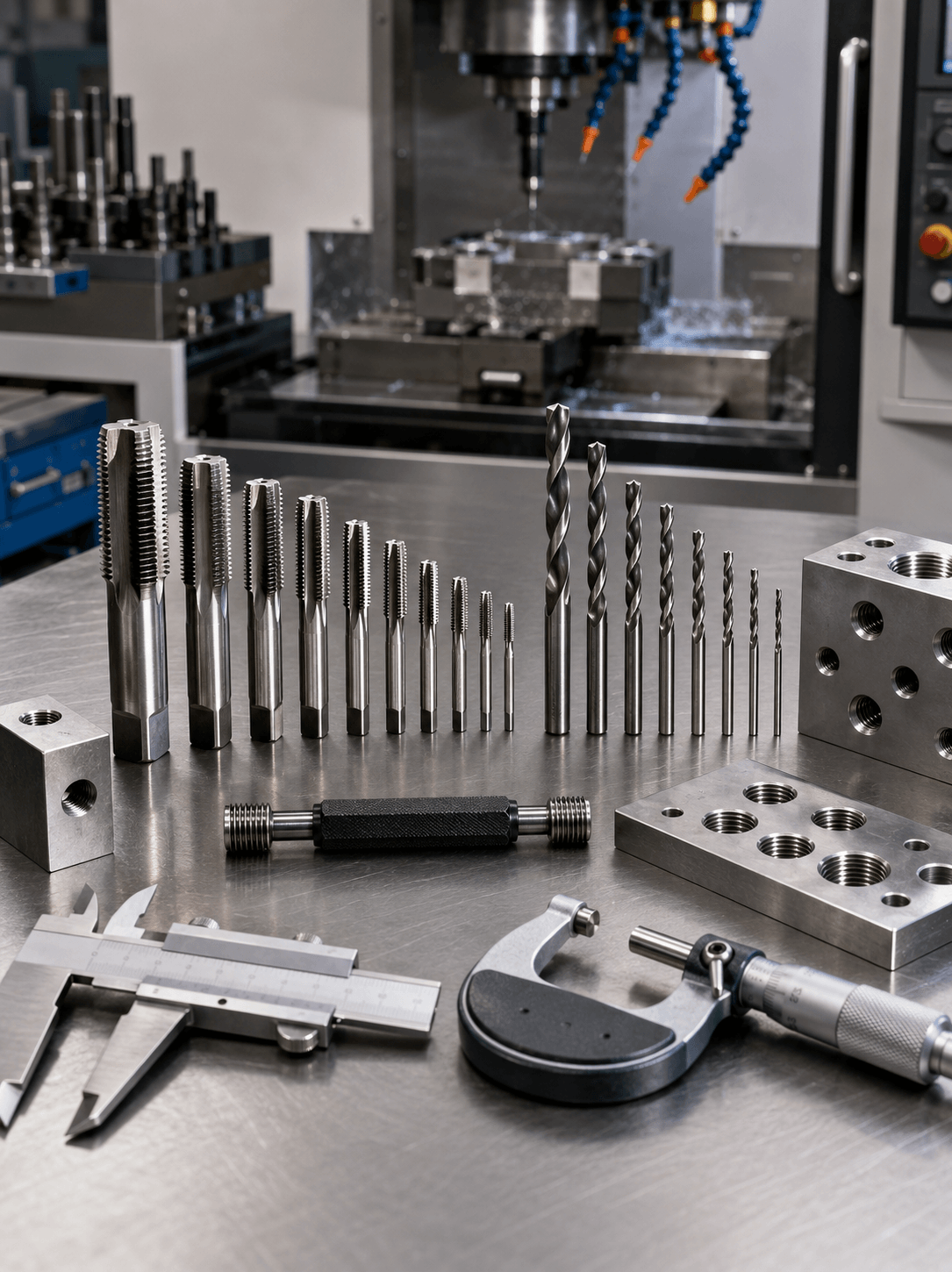
Choosing the correct tap drill size is one of the most important steps in internal threading. If the pre-drilled hole is too small, tapping torque rises sharply and the tap may wear, chip, or break. If the hole is too large, the finished thread may not have enough engagement.
The correct drill size depends on the thread system, pitch, desired thread engagement, tap type, and workpiece material. This guide explains the basic calculations for metric and inch threads and provides practical reference charts for common sizes.
1. What Is Tap Drill Size?
Tap drill size is the diameter of the hole drilled before tapping.
The hole must be smaller than the nominal thread diameter because the tap still needs material to create the thread flanks. The difference between the major diameter and the drilled hole determines how much material the tap cuts or forms.
For standard cutting taps, the goal is to provide enough material for a strong thread without creating unnecessary tapping torque.
2. Simple Metric Tap Drill Formula
For standard ISO metric threads, a widely used shop-floor approximation is:
Tap drill size = Major diameter - Thread pitch
For example, for an M8 × 1.25 thread:
8.00 mm - 1.25 mm = 6.75 mm
A 6.8 mm drill is therefore commonly used.
For an M10 × 1.5 thread:
10.00 mm - 1.50 mm = 8.50 mm
This formula gives a practical drill size for many general-purpose cutting tap applications.
3. Metric Tap Drill Reference Chart
| Thread Size | Pitch | Approx. Tap Drill |
|---|---|---|
| M3 | 0.50 mm | 2.5 mm |
| M4 | 0.70 mm | 3.3 mm |
| M5 | 0.80 mm | 4.2 mm |
| M6 | 1.00 mm | 5.0 mm |
| M8 | 1.25 mm | 6.8 mm |
| M10 | 1.50 mm | 8.5 mm |
| M12 | 1.75 mm | 10.2 mm |
| M16 | 2.00 mm | 14.0 mm |
| M20 | 2.50 mm | 17.5 mm |
These values are common practical starting points. Always verify the required thread standard, tolerance, and manufacturer recommendation before production.
4. Calculating Inch Tap Drill Size
For Unified inch threads such as UNC and UNF, pitch is usually expressed as threads per inch, or TPI.
A simple approximation is:
Tap drill diameter = Major diameter - (1 ÷ TPI)
For example, a 1/4-20 UNC thread has a nominal major diameter of 0.250 inch and 20 threads per inch.
0.250 - (1 ÷ 20) = 0.200 inch
A nearby standard drill size is commonly selected.
For a 1/4-28 UNF thread:
0.250 - (1 ÷ 28) ≈ 0.214 inch
Because UNF has a finer pitch, the required tap drill is larger than for 1/4-20 UNC.
5. Common UNC Tap Drill Reference Chart
| Thread Size | TPI | Common Tap Drill |
|---|---|---|
| #4-40 UNC | 40 | #43 |
| #6-32 UNC | 32 | #36 |
| #8-32 UNC | 32 | #29 |
| #10-24 UNC | 24 | #25 |
| 1/4-20 UNC | 20 | #7 |
| 5/16-18 UNC | 18 | F |
| 3/8-16 UNC | 16 | 5/16 in |
| 1/2-13 UNC | 13 | 27/64 in |
6. Common UNF Tap Drill Reference Chart
| Thread Size | TPI | Common Tap Drill |
|---|---|---|
| #6-40 UNF | 40 | #33 |
| #8-36 UNF | 36 | #29 |
| #10-32 UNF | 32 | #21 |
| 1/4-28 UNF | 28 | #3 |
| 5/16-24 UNF | 24 | I |
| 3/8-24 UNF | 24 | Q |
| 1/2-20 UNF | 20 | 29/64 in |
Letter and number drill sizes are common in inch-based machining, especially in North American workshops.
7. Why Thread Engagement Matters
The simple formulas above provide useful starting points, but they do not directly account for percentage of thread engagement.
A smaller hole produces a higher thread percentage, but also increases tapping torque. A larger hole reduces torque but also reduces thread height.
In many applications, extremely high thread engagement provides little additional practical strength while significantly increasing tapping load.
For this reason, production engineers often balance thread strength against tool life and process reliability rather than simply choosing the smallest possible drill.
8. Cutting Taps vs. Forming Taps
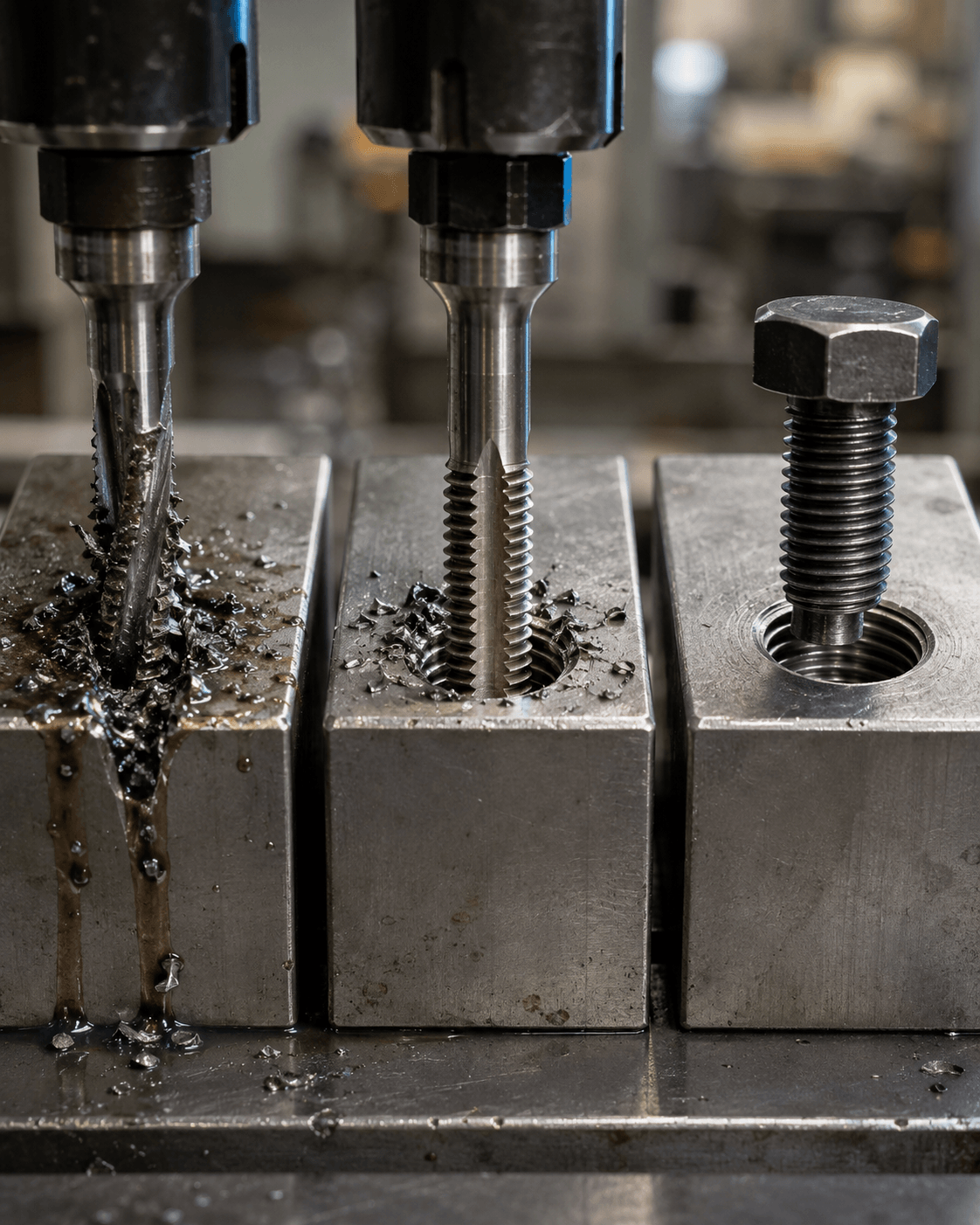
The tap drill size for a forming tap is different from that for a cutting tap.
A cutting tap removes material, so the pre-drilled hole is smaller.
A forming tap displaces material into the thread shape. Because the material flows inward during forming, the starting hole must usually be larger than the hole used for a cutting tap of the same nominal thread size.
Using a cutting-tap drill size with a forming tap can cause extremely high torque or tool failure.
Always use the forming-tap manufacturer's recommended hole diameter.
9. Workpiece Material Can Affect Drill Selection
Material behavior also matters.
Ductile materials such as aluminum, mild steel, and some stainless steels may produce different thread conditions from brittle materials such as cast iron.
In difficult materials, using a slightly larger drill within the allowed thread specification can reduce torque and improve tool life.
For high-volume production, measure the actual drilled hole rather than relying only on the nominal drill diameter, because drill wear and runout can change the finished hole size.
10. Common Tap Drill Mistakes
Several common mistakes can cause tapping problems.
Using the nominal thread diameter as the drill size leaves too little material for a proper thread. Using a drill that is too small increases torque and breakage risk. Using the wrong pitch or TPI gives an incorrect calculation.
Another frequent mistake is using the same drill size for cut taps and roll form taps.
Always confirm the complete thread designation before selecting the drill.
11. A Practical Selection Process
Before drilling, confirm:
- Thread standard: Metric, UNC, UNF, or another system
- Nominal thread diameter
- Pitch or TPI
- Cutting tap or forming tap
- Required thread tolerance
- Workpiece material
- Hole depth
Then calculate or select a starting drill size and verify it against a trusted tap or drill chart.
For production work, make sample threads and inspect them with the correct GO/NO-GO gauge before releasing the process.
Conclusion
Calculating tap drill size is simple in principle but important in practice.
For metric cutting threads, subtracting pitch from nominal diameter provides a useful starting point. For Unified inch threads, subtracting the reciprocal of TPI from the major diameter gives a practical approximation.
These formulas should be combined with standard drill charts, thread tolerance requirements, workpiece material, and tap manufacturer recommendations.
Most importantly, remember that forming taps require different, generally larger, pre-drilled holes than cutting taps.
By selecting the correct tap drill size, manufacturers can reduce tapping torque, prevent premature tool breakage, maintain thread quality, and achieve more consistent production.


