
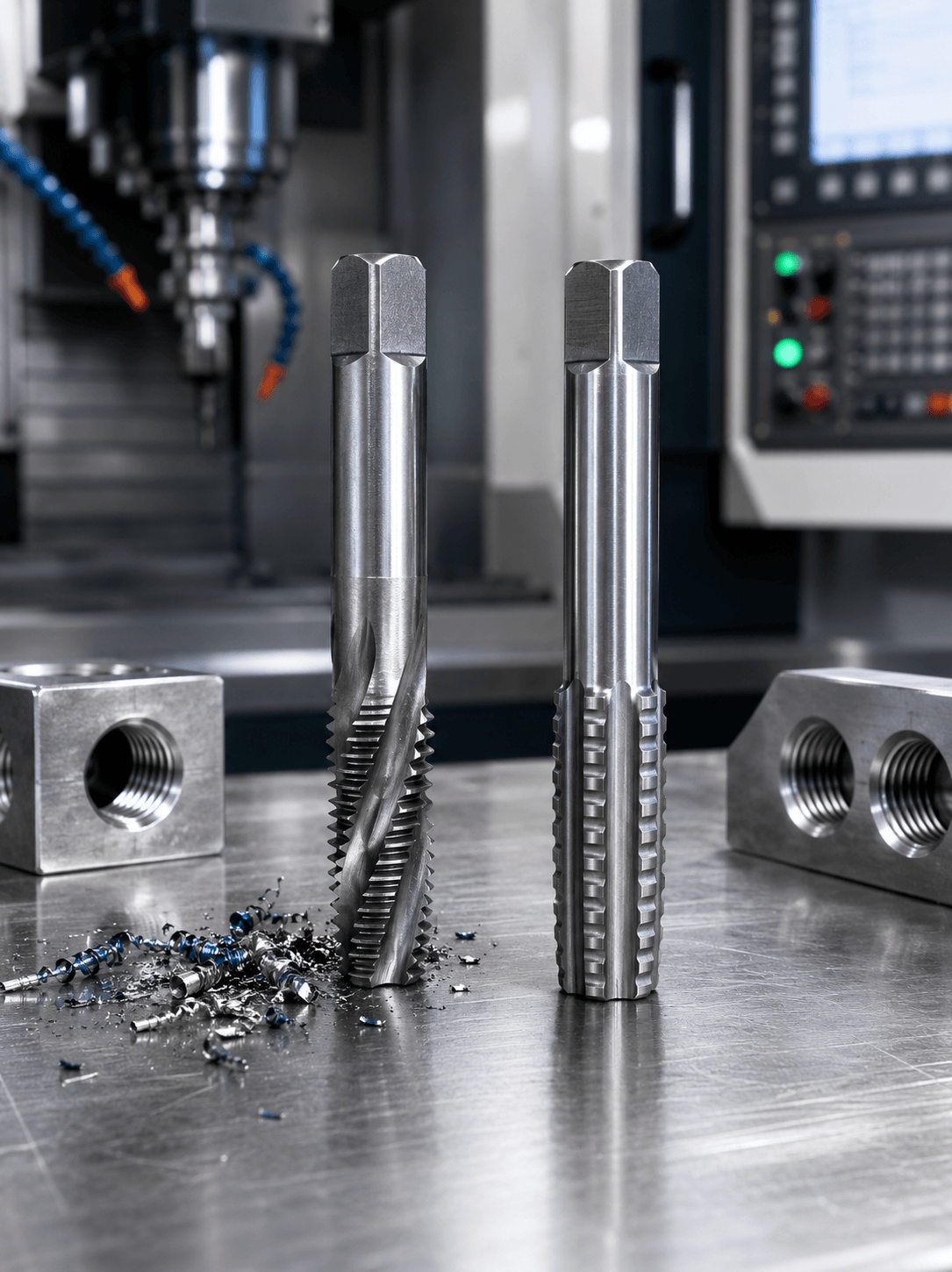
Internal threads can be produced in two different ways: by cutting material away or by plastically forming the material into a thread profile. These methods are represented by cutting taps and roll form taps.
Both tools can produce accurate internal threads, but their chip generation, hole-size requirements, torque, suitable materials, lubrication needs, and applications are different.
1. What Is a Cutting Tap?
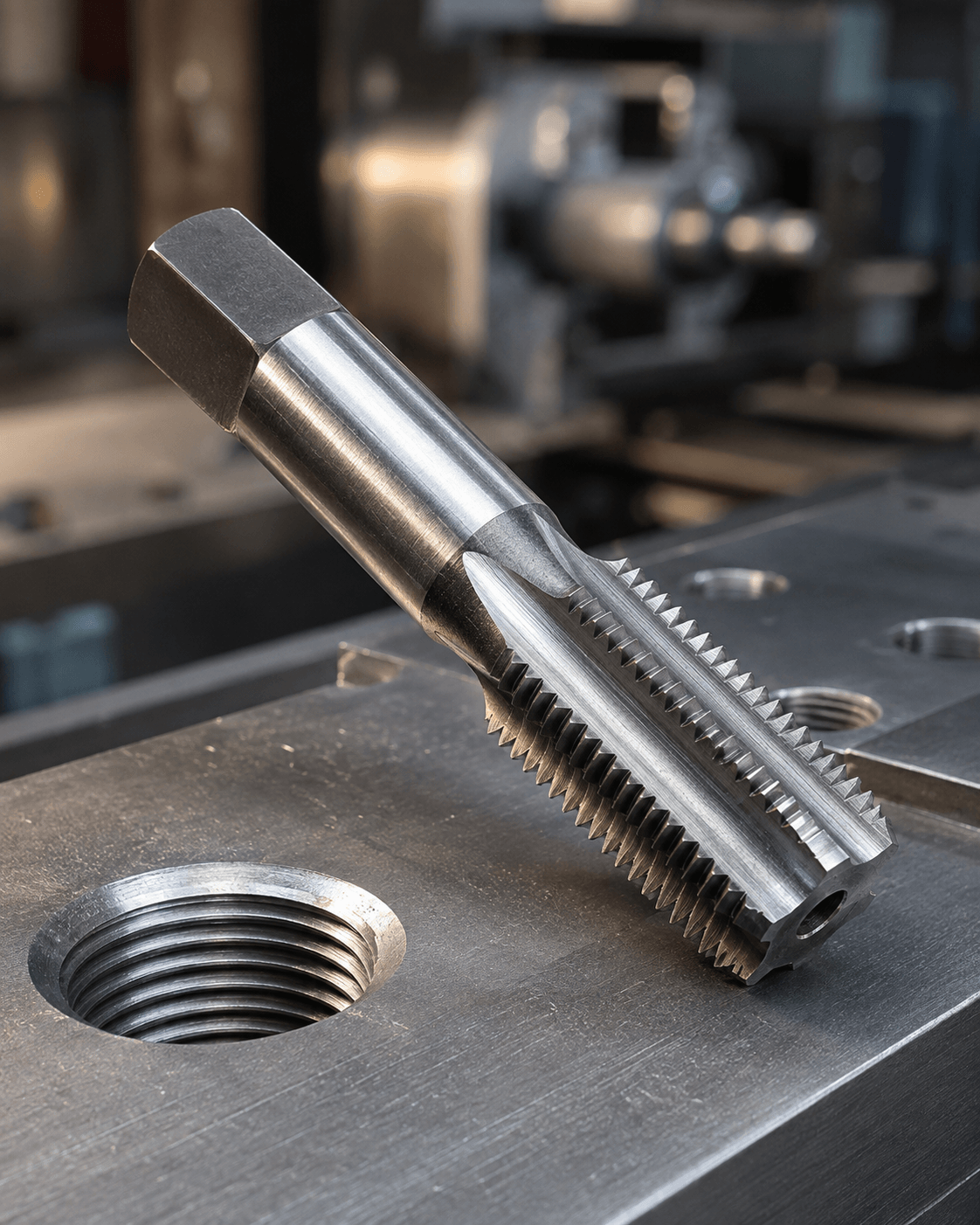
A cutting tap creates an internal thread by removing material from the wall of a pre-drilled hole.
Its cutting teeth shear away metal and create chips that must be evacuated through the flutes. Cutting taps may have straight flutes, spiral point geometry, or spiral flutes.
Spiral point taps are often used for through holes because they push chips forward. Spiral flute taps are commonly selected for blind holes because they pull chips back toward the hole entrance.
Cutting taps are widely used because they can machine many different materials.
2. What Is a Roll Form Tap?
A roll form tap, also called a forming tap or fluteless tap, does not cut chips.
Instead, it plastically displaces the workpiece material. Special lobes on the tap press the material until the required thread profile is formed.
Because no chips are produced, roll forming is attractive in automated production and blind holes where chip packing can be difficult to control.
However, the workpiece must have enough ductility to deform without cracking.
3. Cutting vs. Forming
The main difference is simple: a cutting tap removes material, while a roll form tap moves material.
This affects the entire process.
Cutting taps require chip space and chip evacuation. Form taps require higher forming pressure and more precise control of the pre-drilled hole diameter.
The correct choice depends primarily on material behavior and production conditions.
4. Chip Generation and Control
Cutting taps generate chips. If these chips are not removed efficiently, they may become trapped between the tap and workpiece, increasing torque and causing thread damage or tool breakage.
This is why flute design must match the hole type.
Roll form taps eliminate chip-control problems because no chips are produced. This is one of their strongest advantages in high-volume CNC machining and deep blind-hole applications.
5. Suitable Workpiece Materials
Cutting taps can be used in carbon steel, stainless steel, cast iron, aluminum, brass, and many alloy steels.
Roll form taps require materials with sufficient ductility. Common applications include aluminum alloys, low-carbon steels, copper alloys, and other formable metals.
Brittle materials such as cast iron are generally unsuitable because they cannot plastically flow into the required thread shape.
6. Pre-Drilled Hole Size
The pre-drilled hole diameter is important for both tap types, but it is especially critical for roll form taps.
With a cutting tap, a smaller hole increases material removal and tapping torque.
With a form tap, hole size determines how much material is displaced. If the hole is too small, torque can become excessive. If it is too large, the thread crest may not form completely.
Accurate drilling is essential for reliable roll tapping.
7. Torque Requirements
Roll form taps usually require higher torque than comparable cutting taps because they deform the workpiece instead of removing material.
The machine spindle, holder, and fixture must be able to handle this load.
Cutting taps generally require less forming pressure, but torque can still rise sharply if chips pack in the flutes, lubrication is poor, or the hole is undersized.
8. Thread Strength and Surface Finish
Roll-formed threads can provide smooth surfaces because the material is compressed rather than cut. The forming process may also produce favorable material flow around the thread profile.
Cut threads can also achieve excellent strength and surface quality when geometry and machining conditions are correct.
Final performance depends on workpiece material, thread engagement, hole preparation, and process control.
9. Lubrication Requirements
Lubrication is important in both methods.
Cutting taps need lubrication to reduce friction, temperature, and material adhesion while supporting chip evacuation.
Roll form taps operate under high contact pressure, so effective lubrication is especially important. Poor lubrication can cause excessive torque, galling, and premature wear.
10. Tool Life and Production Efficiency
Roll form taps can provide long tool life in suitable materials because there are no chips to jam in the flutes and the tool does not rely on conventional cutting edges in the same way as a cut tap.
Cutting taps remain more versatile and are usually preferable when materials vary or cannot be formed reliably.
Tool life for both types depends on substrate, coating, speed, lubrication, alignment, and hole quality.
11. Blind Holes and Through Holes
Cutting taps require different chip-control strategies. Spiral point taps are commonly used for through holes, while spiral flute taps are often preferred for blind holes.
Roll form taps can be used in both through and blind holes because no chips are created.
12. When to Choose Each Tap
Choose a cutting tap when the material is brittle, difficult to form, or when broad application flexibility is required.
Choose a roll form tap when the material is ductile, chip-free production is valuable, and the hole diameter can be controlled precisely.
In high-volume automotive, electronics, and general manufacturing, roll taps can offer excellent process stability in suitable materials.
For cast iron, difficult-to-form alloys, or mixed production, cutting taps are usually more practical.
Conclusion
Cutting taps and roll form taps produce the same basic result—an internal thread—but they use different mechanisms.
Cutting taps remove material and generate chips. They are versatile and suitable for a wide range of materials.
Roll form taps plastically displace material and produce no chips. They can provide smooth threads, long tool life, and reliable performance in ductile materials, especially in automated production.
The best choice depends on material ductility, hole type, pre-drilled diameter, machine torque, lubrication, production volume, and thread requirements.
By matching the tapping method to the application, manufacturers can improve thread quality, reduce tool failures, and achieve more stable production.


