
Tap regrinding can reduce tooling costs, especially when expensive taps are used in high-volume production. However, regrinding is not automatically economical. The process changes cutting geometry, tool dimensions, and coating condition. If the reconditioned tap cannot maintain the required thread quality or tool life, the apparent savings may disappear quickly.
This guide explains when tap regrinding makes financial sense, how it affects performance, and which factors manufacturers should evaluate before choosing regrinding instead of replacement.
1. What Is Tap Regrinding?
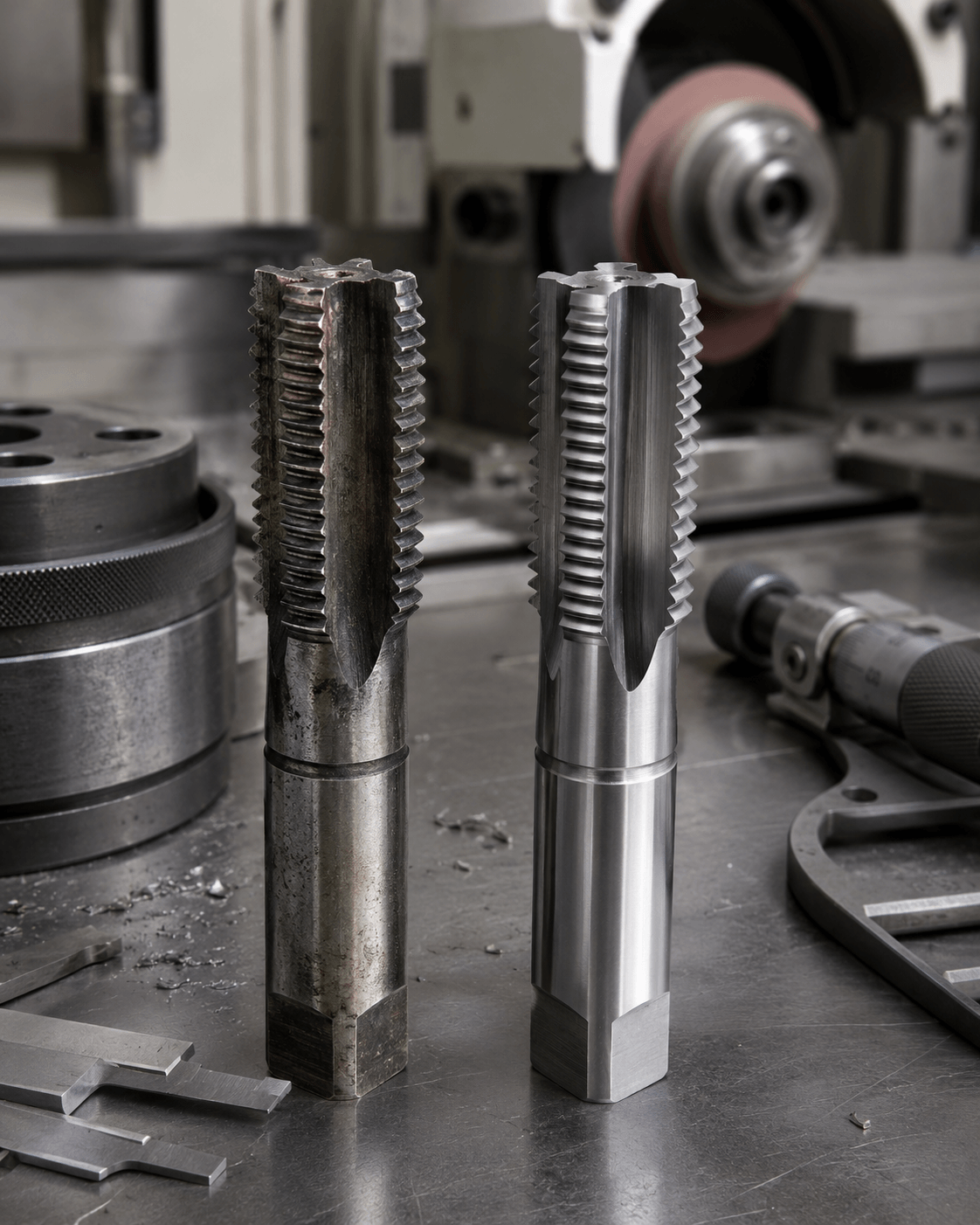
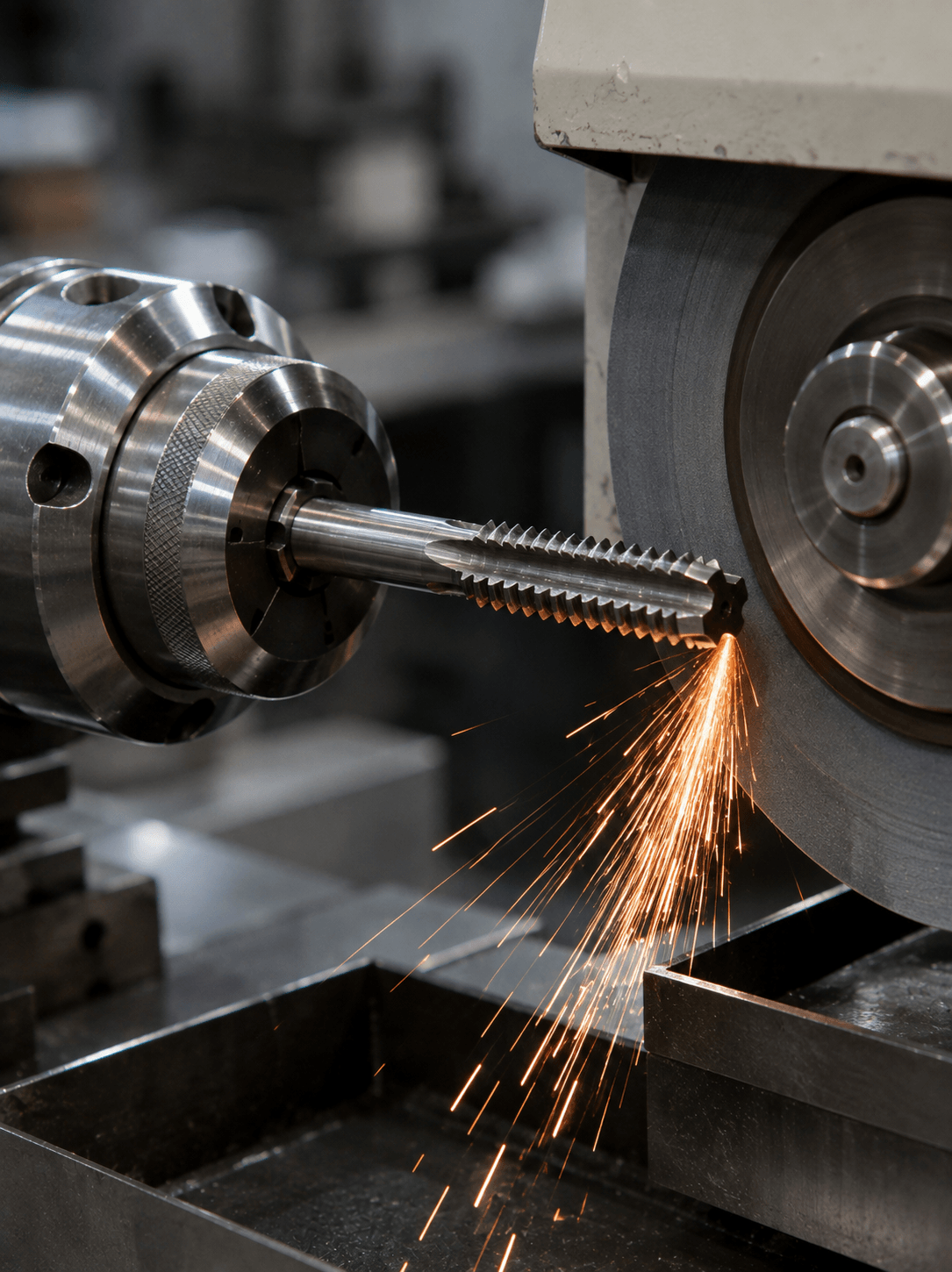
Tap regrinding restores worn cutting edges by removing a small amount of material from selected surfaces of the tap.
Depending on the tap design, regrinding may restore the chamfer, cutting face, relief surfaces, or other functional geometry. The goal is to recover cutting ability without replacing the entire tool.
Regrinding is more common with larger, more expensive taps, special taps, and high-performance tools.
2. Why Manufacturers Consider Regrinding
The main reason is cost.
A high-quality HSS-Co, PM-HSS, carbide, or custom tap can represent a significant tooling investment. If the tool body remains in good condition after the cutting edges become worn, regrinding may extend its useful life.
For large-diameter or custom taps, the savings can be attractive because reconditioning may cost much less than a new tool.
3. Compare Cost per Hole
The correct comparison is not simply:
New tap price vs. regrinding price
Manufacturers should compare total cost per acceptable threaded hole.
A useful formula is:
Cost per hole = Total tool cost ÷ Number of acceptable holes produced
For a reground tap, total cost may include grinding, recoating, shipping, inspection, and handling.
If a reground tool costs 40% of a new tap but produces only 30% of the original tool life, replacement may actually be more economical.
4. How Regrinding Affects Tap Geometry
Every regrinding operation removes material.
This can change the relationship between the cutting edge, relief, flute geometry, and chamfer. If too much material is removed or the geometry is restored incorrectly, tapping torque and chip flow may change.
For precision machine taps, even small geometric changes can influence performance. Regrinding should therefore follow the original design as closely as possible.
5. Thread Size and Dimensional Control
Regrinding can also influence the final thread dimensions.
Some operations mainly restore cutting faces and have limited effect on thread size, while others may change effective cutting geometry.
After reconditioning, the tap should be inspected to confirm that it still meets the required specification.
For applications with tight thread tolerances, dimensional verification is especially important before the reground tool returns to production.
6. Coating Loss and Recoating
Many production taps use PVD coatings such as TiN, TiCN, or TiAlN.
Regrinding removes coating from the surfaces being machined. If the tap returns to service without recoating, the exposed cutting areas may wear faster.
Recoating can restore surface protection, but it adds cost and lead time.
The economic analysis should therefore include both regrinding and recoating when coating performance is important.
7. Tool Life After Regrinding
A properly reground tap can provide useful additional life, but it should not be assumed that every regrind will match new-tool performance.
Actual life depends on remaining tool condition, regrinding quality, coating, workpiece material, and machining parameters.
Manufacturers should record the number of acceptable holes produced by new and reground taps separately. This makes the comparison much more reliable.
8. Which Taps Are Good Candidates?
Regrinding is most attractive for expensive tools.
Typical candidates include large-diameter taps, custom thread taps, special-purpose taps, PM-HSS taps, carbide taps, and tools with long replacement lead times.
Small standard HSS taps are often inexpensive enough that regrinding, transport, inspection, and handling may cost more than replacement.
9. When a Tap Should Not Be Reground
Not every worn tap can be recovered safely.
A tap should generally be rejected if it has serious tooth chipping, cracks, bending, heavy flute damage, severe corrosion, or dimensional defects that cannot be corrected.
Regrinding a structurally damaged tool can increase breakage risk.
The tap should therefore be inspected before reconditioning.
10. Regrinding and Chip Evacuation
Chip control is critical in tapping.
Spiral flute and spiral point taps use specific geometry to move chips in the required direction. Poor regrinding can alter these cutting relationships and reduce chip evacuation performance.
If chips begin to pack after regrinding, tapping torque can rise significantly.
Complex tap geometries should therefore be reconditioned by a supplier with suitable grinding equipment and technical experience.
11. Production Consistency Matters
A regrinding program is valuable only if the results are repeatable.
Factories should compare reground taps using tool life, spindle load, tapping torque, gauge results, breakage rate, and thread surface quality.
If performance varies widely between regrind batches, the process may create more production risk than savings.
12. When Regrinding Makes Economic Sense
Regrinding is usually worth considering when the tap has a high replacement cost, the tool body remains in good condition, the geometry can be restored accurately, and the reground tool produces enough acceptable threads to justify the process.
It is less attractive when taps are inexpensive, downtime is costly, reconditioning lead time is long, or thread tolerances are extremely sensitive.
The decision should be based on actual production data.
Conclusion
Tap regrinding can reduce tooling cost, but only when the complete economics are considered.
The main benefits are lower replacement cost and longer use of expensive tooling. The main risks are geometry changes, reduced coating protection, inconsistent tool life, and thread-quality variation.
Manufacturers should compare new and reground taps using cost per acceptable hole, not purchase price alone.
For large, custom, or expensive taps, professional regrinding and recoating can provide significant value. For small standard taps, replacement is often more economical.
A successful regrinding program depends on careful tool inspection, accurate geometry restoration, dimensional verification, and consistent production testing.


