
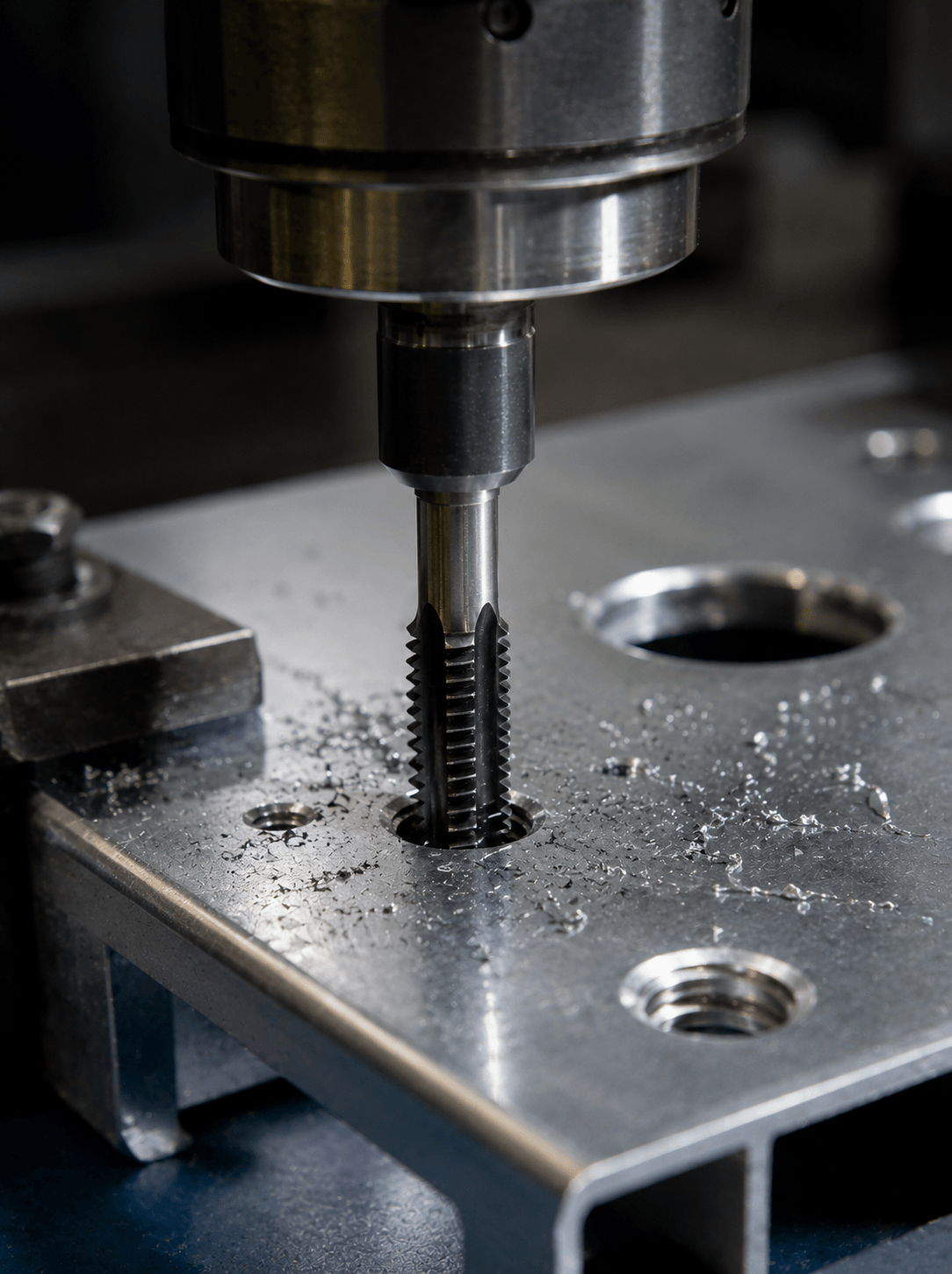
Thread tapping in sheet metal is more challenging than tapping thick machined parts. The material is thin, thread engagement is limited, and excessive tapping force can deform the sheet around the hole. If the process is not controlled carefully, the result may be stripped threads, distorted panels, poor alignment, or inconsistent assembly torque.
Successful sheet-metal tapping depends on hole preparation, tap type, material thickness, machine support, and lubrication. This guide explains how to improve thread strength and dimensional stability.
1. Why Sheet Metal Threads Are Difficult
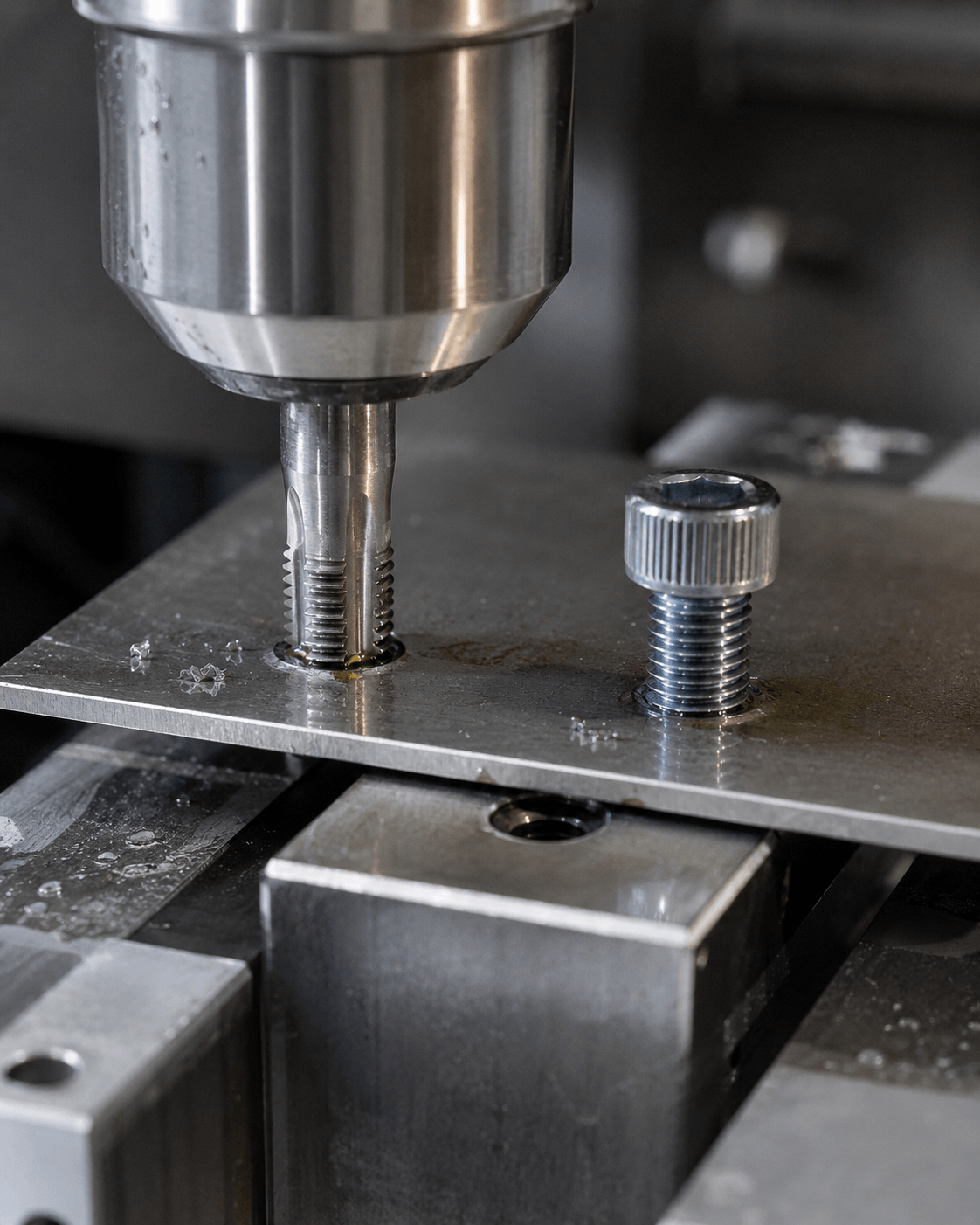
A conventional internal thread needs enough material thickness to provide sufficient engagement with the mating screw.
In thin sheet, only a small number of thread turns may be available. If the load is too high, the threads can shear or strip before the fastener reaches the required clamp force.
Thin material can also bend around the hole during drilling and tapping, especially when the sheet is poorly supported or tapping torque is excessive.
2. Check Material Thickness Before Tapping
The first step is to confirm whether the sheet is thick enough for the required thread.
If the material is too thin, simply tapping the original hole may not provide a reliable connection. Manufacturers may instead use an extruded hole, formed boss, clinch nut, rivet nut, welded nut, or threaded insert to increase effective engagement.
The correct solution depends on load, assembly frequency, cost, and production volume.
3. Use the Correct Pre-Drilled Hole Size
Hole diameter strongly affects tapping torque and thread strength.
If the pre-drilled hole is too small, the tap removes or displaces too much material. Torque rises, the sheet may distort, and the tap can break.
If the hole is too large, thread height is reduced and the finished thread may strip under load.
Measure the actual hole diameter rather than relying only on the nominal drill size. Burrs and punching distortion can also affect the opening.
4. Consider Form Taps for Ductile Sheet Metal
Roll form taps can be effective in ductile sheet materials such as low-carbon steel, aluminum, and some stainless steels.
Instead of cutting chips, a form tap plastically displaces material to create the thread. This eliminates chip evacuation problems and can produce smooth thread flanks.
Form tapping is particularly useful when the hole has been extruded or flanged to increase material thickness around the thread.
However, the pre-hole diameter must be controlled closely because forming torque depends strongly on how much material is displaced.
5. Use Cut Taps When Forming Is Unsuitable
Cutting taps remain necessary for brittle or less formable materials and for applications where forming is unsuitable.
For through holes, spiral point taps can push chips forward. For thicker blind features, spiral flute taps may pull chips back toward the entrance.
In thin sheet, a sharp cutting edge is important because it reduces force and helps prevent distortion around the hole.
6. Support the Sheet During Tapping
Poor support is a major cause of distortion.
If the sheet flexes while the tap enters the hole, the surrounding material may bend or twist. This can create a raised or depressed area around the thread and may also cause misalignment.
Use a rigid fixture, backing plate, or close support around the tapping area whenever possible. Good support becomes increasingly important with larger threads and higher tapping torque.
7. Control Tapping Torque
Excessive torque can deform thin material even if the tap does not break.
High torque may be caused by an undersized hole, worn tap, poor lubrication, incorrect geometry, or material adhesion.
Monitor spindle load or tapping torque during production. A gradual increase can indicate tool wear or changing hole conditions.
Using sharp, application-specific taps and replacing them before severe wear develops helps keep torque stable.
8. Prevent Thread Stripping
Thread stripping occurs when the internal thread cannot carry the required axial load.
The main causes are insufficient material thickness, low thread engagement, oversized holes, weak material, or excessive fastener torque.
To improve resistance, manufacturers can increase effective thread length with extruded holes or threaded inserts and control final assembly torque carefully.
A stronger tap cannot compensate for insufficient sheet thickness. The joint itself must provide enough material to carry the load.
9. Minimize Burrs and Hole Distortion
Punching or drilling can leave burrs around the hole. Large burrs may affect tap entry, thread alignment, and final assembly.
Deburring before tapping can improve consistency. Punch condition should also be monitored because worn tooling can create tapered or distorted holes.
Accurate hole preparation reduces both thread defects and tapping torque.
10. Use Suitable Lubrication and Alignment
Lubrication reduces friction and helps protect the tap and sheet surface. This is especially important with stainless steel and aluminum.
For form tapping, lubrication is critical because the process relies on high contact pressure.
The tap should also enter the hole perpendicular to the sheet. Misalignment can enlarge the hole, distort the thread, and bend the surrounding material.
In CNC production, rigid tapping or guided holders can improve feed synchronization and alignment.
11. Inspect the Finished Thread
Do not evaluate a sheet-metal thread only by checking whether a screw can enter.
Use the correct GO/NO-GO gauge when dimensional control is required. Also inspect the surrounding sheet for dishing, cracking, burrs, or deformation.
For critical joints, pull-out, torque, or assembly testing can confirm that the thread supports the expected load.
Conclusion
Reliable sheet-metal tapping requires more than selecting the correct thread size.
Manufacturers must consider sheet thickness, pre-hole diameter, tap type, material ductility, fixture support, lubrication, alignment, and final assembly load.
Form taps can provide strong, chip-free threads in suitable ductile materials, especially when combined with extruded holes. Cutting taps remain useful where forming is not appropriate.
When the sheet is too thin for safe thread engagement, inserts, clinch nuts, or other fastening solutions may be more reliable than direct tapping.
By controlling hole preparation, tapping torque, support, and thread engagement, manufacturers can reduce stripped threads, prevent panel distortion, and achieve more consistent sheet-metal assemblies.


